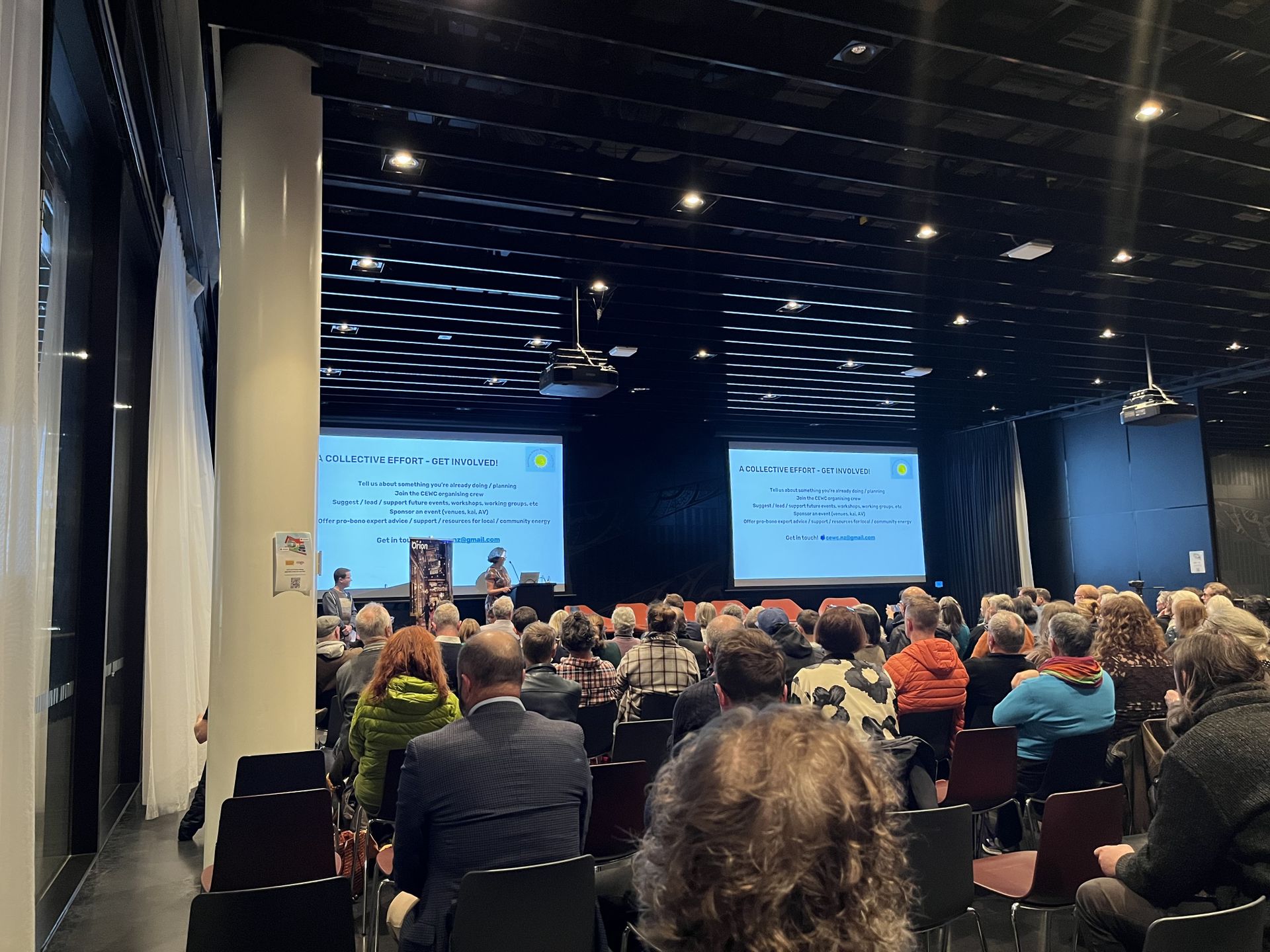
Alimentary Systems recently attended ReEnergising! – Local Action to Accelerate Energy Transitions, an event that brought together leading voices on how Aotearoa New Zealand can move faster on its energy transition — without waiting for policy to catch up.
Dr Rod Carr, former Chair of He Pou a Rangi — the Climate Change Commission — opened with a challenge that set the tone for the day: New Zealand needs to reduce its dependence on gas and fossil fuels, and the wait for the right policies or subsidies is a luxury we no longer have. He also made a point that doesn't get said often enough — past generations made the wrong energy choices, and admitting that honestly is the first step toward building better alternatives.
It's a message that resonates deeply with the work we do at Alimentary Systems. Our Bio-Resource Recovery Plants are designed precisely for the kind of local, practical, no-more-waiting action Dr Carr is calling for — turning organic waste and sewage sludge into biogas, bio-fertiliser, and carbon credits, right where communities need it.
Buildings Built for the Wrong Climate
One basic problem kept surfacing: many of the homes that will still be standing in 2100 simply aren't energy efficient. They're poorly insulated and built for a different energy reality than the one we're heading into.
Wellington was raised as a cautionary tale. Even as national policy signalled a shift away from gas, the city continued connecting new houses to the gas network. Now, those pipes need to be ripped out — at a cost of around $2,500 per household. It's a pattern playing out nationally, with gas disconnection costs ranging from $700 to $7,500 depending on location, and residential gas supply entering what analysts have called a "death spiral" — rising network costs spread across a shrinking customer base.
The lesson is clear: infrastructure choices made today will be extraordinarily hard and expensive to undo. Short-term decisions create long-term liabilities. Part of the problem, as speakers noted, is that the electricity sector can be protective of its own turf rather than focused on what the wider community actually needs.
Transport: The Other Big Lever
Professor Simon Kingham — Professor of Geography at the University of Canterbury and Chief Science Advisor at the Ministry of Transport — brought a practical lens to the transport challenge. His advice was concrete rather than abstract: avoid or reduce travel where you can, and design cities so people don't need to travel far in the first place.
The "15-minute city" model, where daily needs sit within a short walk or ride, was held up as a genuinely effective way to cut transport demand. Where travel can't be avoided, walking, cycling, public transport, and vehicle sharing all help — but speakers were careful to note that simply making public transport cheaper or faster isn't enough to shift behaviour. People need to feel safe using it, and practical factors like onboard Wi-Fi matter too. When a commute becomes productive time rather than dead time, the calculation changes.
For heavy transport, New Zealand has a real advantage as an island nation — the ability to manage its own freight emissions more directly than countries with cross-border networks. Investment in rail and charging infrastructure for heavy trucks is a sensible priority.
Aviation: No Easy Answers
Aviation is where the transition gets genuinely difficult. New Zealand doesn't have an easy local alternative energy source for aircraft, and not all proposed future fuels are equal. Claire Waghorn made the case that electric aviation has a role, but realistically only for small regional flights. For larger aircraft, green hydrogen is a more plausible long-term option — though it's not yet a solved problem.
Shifting Demand, Not Just Cutting It
One point that's easy to overlook: energy consumption can be shifted in time, not just reduced. As Nigel Barbour reminded the audience, moving usage to different times of day can lower energy costs for consumers without necessarily cutting overall demand. The transition isn't only about using less — it's about using energy more intelligently.
This is another area where decentralised energy production — including biogas from anaerobic digestion — has a role to play. Distributed generation from organic waste processing can provide baseload renewable energy that complements intermittent sources like wind and solar, reducing pressure on the grid at peak times.
Where Biogas and Biomethane Fit In
The conversations at ReEnergising! underscored a point that's central to our work at Alimentary Systems: the energy transition isn't just about switching from fossil fuels to electricity. It's about building circular systems that recover energy and resources from waste streams that would otherwise create environmental liabilities.
New Zealand's Biomethane Opportunity
The 2026 Biomethane Strategy and Action Plan outlines how renewable gas could supply significant volumes by 2035 and meet up to half of the country's gas demand by 2050. Biogas produced through anaerobic digestion of organic waste — including the food waste, sewage sludge, and agricultural residues our BRRPs are designed to process — offers a genuine pathway to decarbonise gas supply while simultaneously addressing waste management challenges.
The IEA notes that New Zealand already generates over 80% of its electricity from renewable sources. The key challenge lies in decarbonising other end-use sectors — precisely where biogas and biomethane sit.
The Cost of Waiting
The closing point of the day was the hardest one. New Zealand has waited far too long to begin a transition that could have been smoother and cheaper. Because of that delay, the shift we now face will be expensive — and it's no longer avoidable.
What we can still influence is how the cost is distributed. The task now is to keep the transition moving while actively advocating for vulnerable communities, so that the people least able to absorb the impact aren't the ones carrying the heaviest burden.