How a 113-year-old factory fire, a reinvented tram company, and a discipline born in New Zealand are reshaping how we think about sustainability — and why engineers, not policymakers, will lead the way.
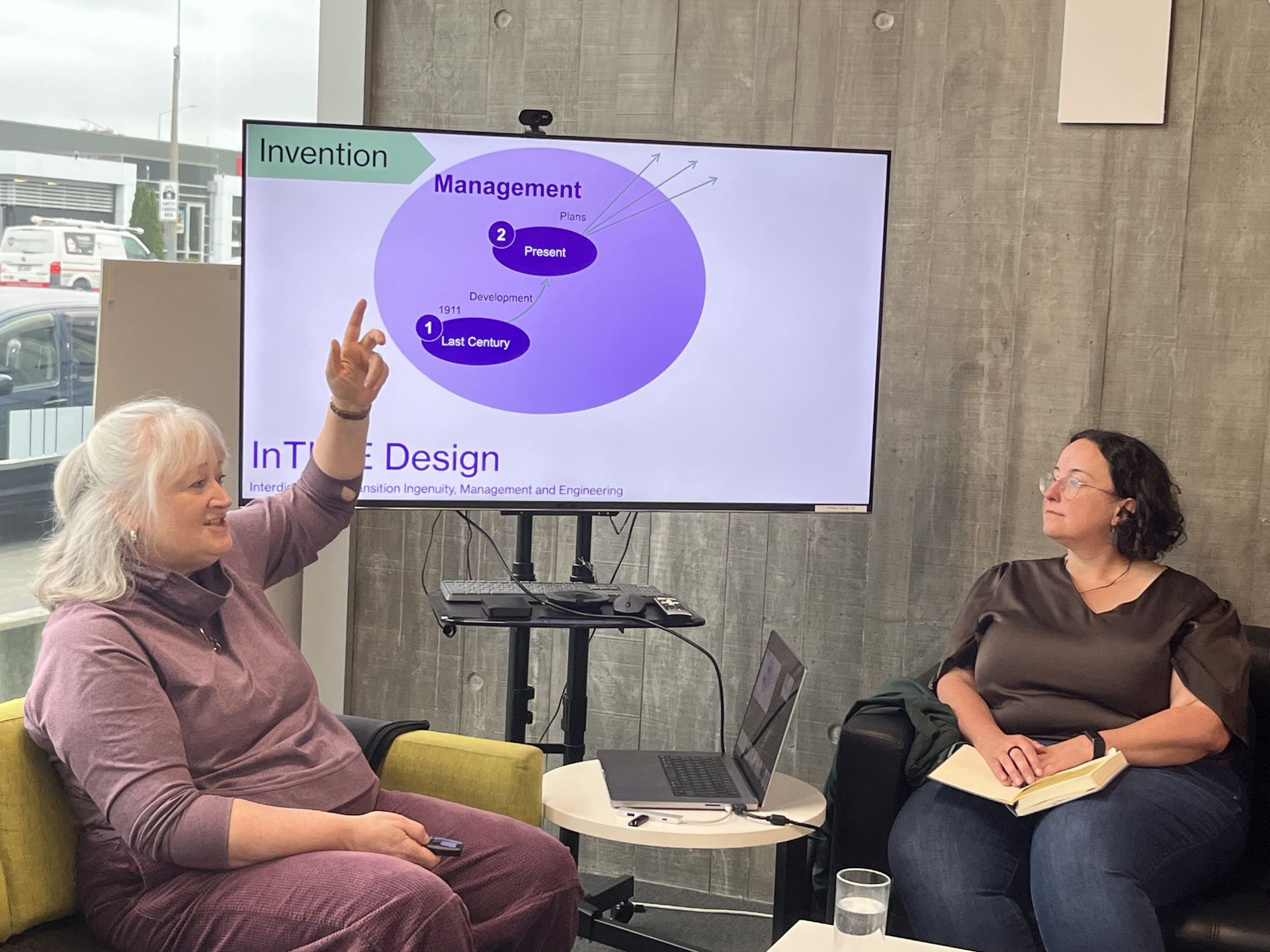
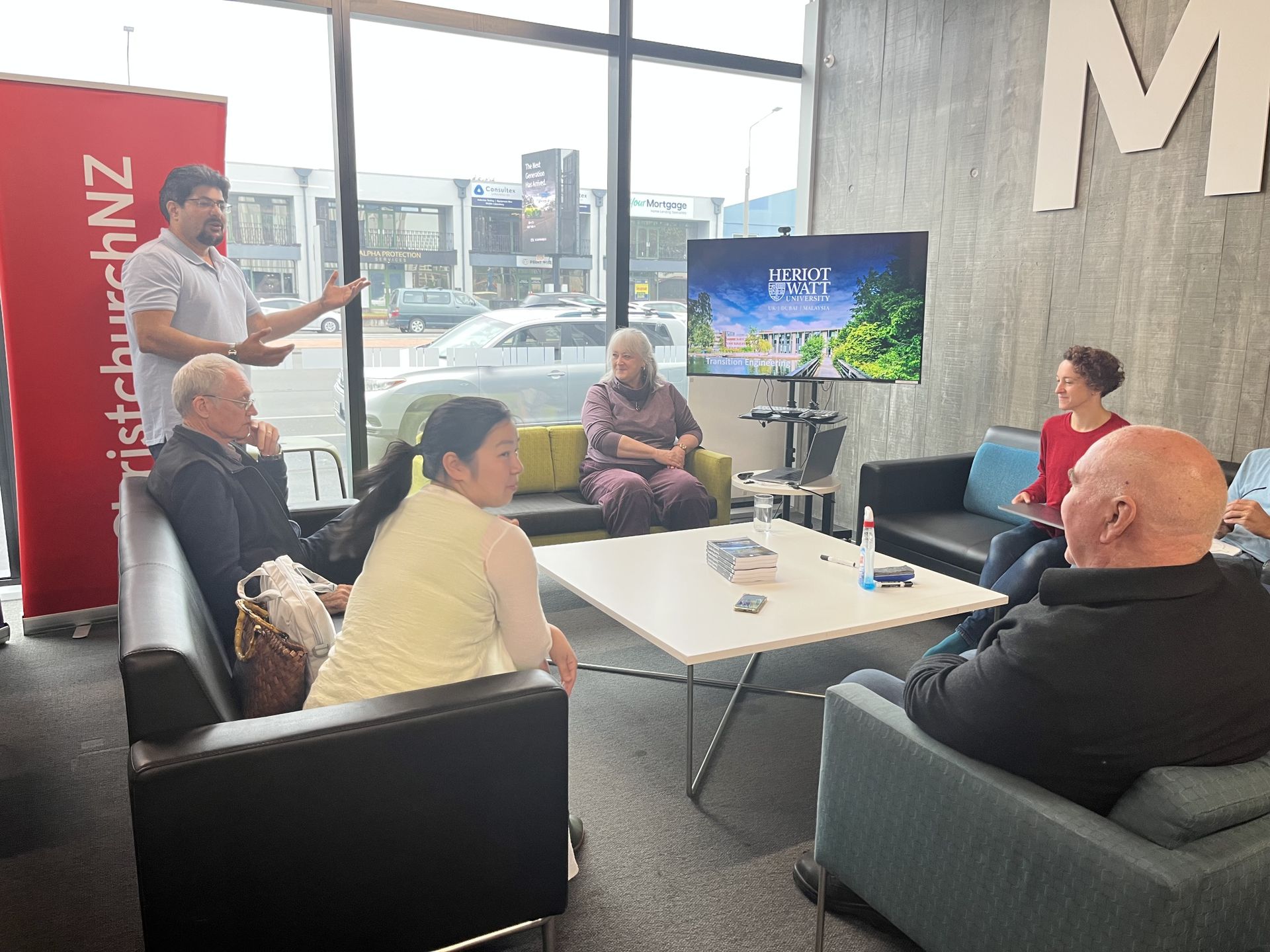
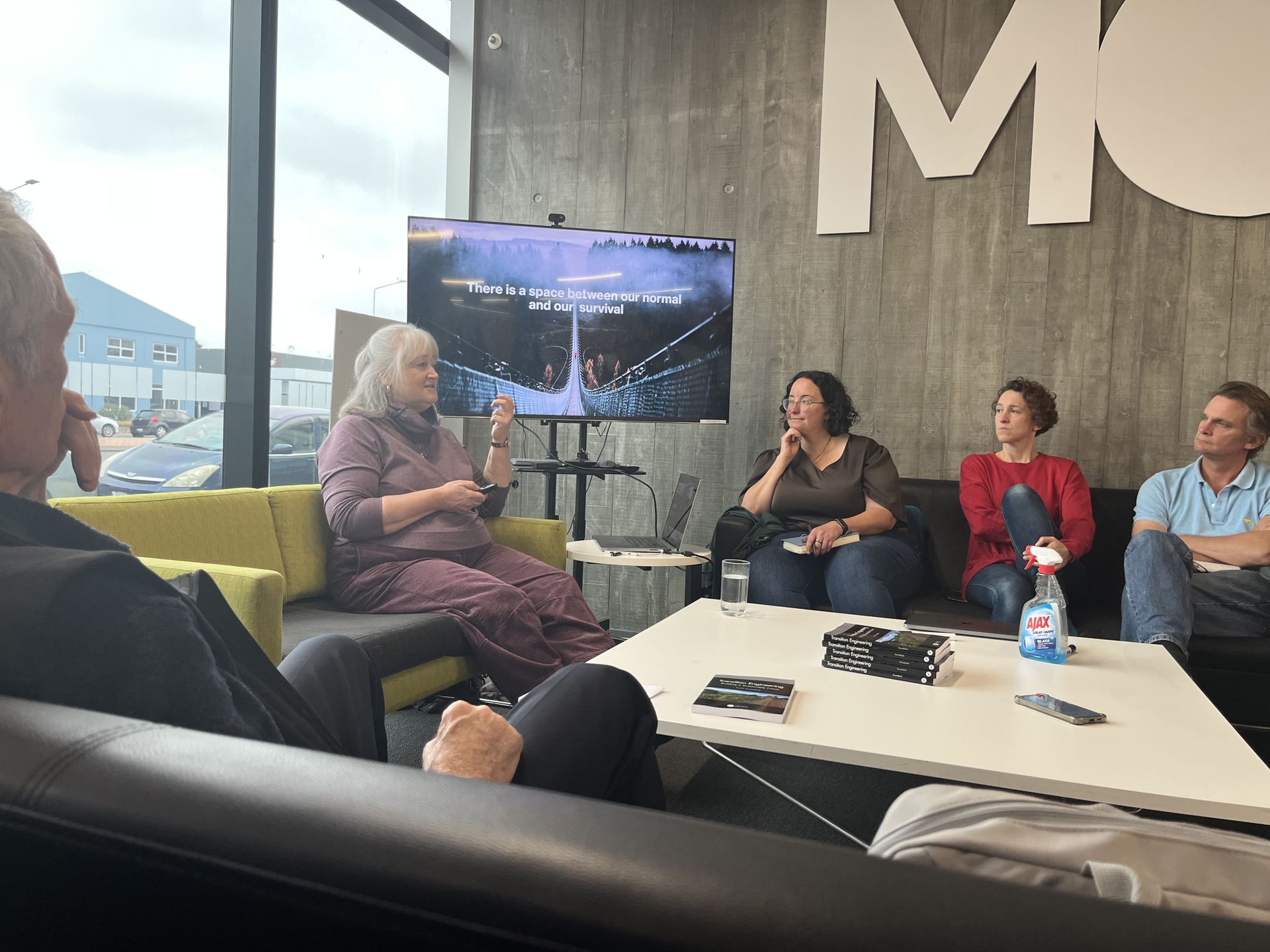
We recently hosted Professor Susan Krumdieck for a talk at the Alimentary Systems lab, and what unfolded over the following 80 minutes was one of the most compelling reframings of sustainability I've encountered in years of working in the cleantech space. Professor Krumdieck didn't talk about solar panels. She didn't pitch a technology. She told the story of how normal changes — and why understanding that process is the single most important capability we can develop right now.
What follows is the substance of that conversation, distilled for anyone working in infrastructure, waste, energy, or the broader transition economy. If you're an engineer, a council officer, an investor, or just someone who feels the gap between what we know we need to do and what we're actually doing — this is for you.
The Problem With Good Things
Professor Krumdieck opened with a provocation that landed hard in a room full of engineers: wanting a good thing is not an effective way to stop a bad thing.
Think about that for a moment. Our entire climate response framework — policy, investment, public discourse — is built on the premise that if we produce enough good things (electric vehicles, solar panels, green hydrogen), the bad things will recede. But Professor Krumdieck's 21 years of applied research, first at the University of Canterbury and now at Heriot-Watt University in Scotland, suggests otherwise. The good things sit on the same trajectory as the bad things. They share the same growth logic, the same consumption patterns, the same economic assumptions. They are, in transition engineering terms, "Door Number Two."
And Door Number Two doesn't change the system. It decorates it.
The second provocation was equally uncomfortable: there are no sustainable solutions. There are only difficult choices about what to change and how to adapt. If you've sat through enough council workshops or investor presentations where the phrase "sustainable solutions" gets repeated like an incantation, you know intuitively that something is off. Professor Krumdieck gave that intuition a name and a framework.
The Three Doors
The core model Professor Krumdieck presented — developed through work with senior oil industry executives alongside her colleague Dr Jack Bolton — is elegant in its simplicity:
Door Number One is business as usual. It's got continuous improvement, risk management, and everything we know about running a functioning enterprise. It also leads, on its current trajectory, to global unsustainability and predictable loss. You can see it in the data. You know it in your bones. But you can't slam this door shut — you can't simply stop having factories or logistics networks or cities.
Door Number Two is what most sustainability effort looks like today. Green growth, eco-products, carbon offsets. These aren't bad. But they're not changing the trajectory. They sit on the same growth curve. They assume the same economic framing.
Door Number Three is the space that transition engineering opens up. It's the unthinkable opportunity — the reinvention and regeneration of industries and systems into something that meets essential human needs without the mechanisms currently destroying the conditions for those needs to continue being met. You cannot see Door Number Three if you're not deliberately looking for it.
This framework came directly from a project Bolton led with oil industry executives. These were people who cared deeply about climate change, about their grandchildren's future — but who had no conceptual space within their business-as-usual frame to imagine what else they would do. The three doors framework unlocked that space.
What would the oil industry look like, Krumdieck asked, if it treated petroleum as a precious, finite resource to be stewarded over 600 years at a true-cost price of $300 per barrel — including the carbon price global economists agree is necessary? The executives didn't resist. They said: we could do that. The profit margin is better. And with the capital, expertise, and political leverage we have, we could reform entire cities into places that don't depend on private automobiles.
They just had to imagine it first.
How Normal Actually Changes: A Proof by History
One of the most powerful aspects of Professor Krumdieck's presentation was her use of history — not as metaphor, but as evidence of a repeatable pattern. And the pattern is this: engineering disciplines, not policy, drive systemic change. Policy follows, often decades later.
The case study that anchored the talk was the Triangle Shirtwaist Factory disaster of 1911. On that single day in Manhattan, 148 young women died in a factory fire. There were no fire escapes, no extinguishers, no warning systems, no water pressure that could reach the ninth floor. Workers were locked inside during their 16-hour shifts to prevent them from leaving with merchandise. And here's the part that reframes everything: the day before, 180 factory workers had died in a separate fire. The week before, 170 more. This was not unusual. What was unusual about the Triangle fire was that the bodies were visible — women jumping from windows, hanging on to each other, on fire, in full view of the public.
Two weeks later, 62 engineers — mechanical and industrial engineers, the people responsible for the factories — held a private meeting. No policymakers. No managers. Just engineers. They invented a word: preventable. They committed to preventing what is preventable, to being honest with the public about hazards, and to applying science to the problem.
They went back and studied the fire. They found the locked doors. They wrote the first safety standard — still in effect today — requiring two unlocked exits from any workplace. Within 11 years, the American Society of Safety Engineers was formed. The insurance industry noticed that death rates collapsed in New York while remaining unchanged in Pennsylvania, and began requiring compliance as a condition of coverage.
The federal government? The Occupational Health and Safety Act didn't arrive until 1970 — 59 years later. And then economists, another 30 years on, calculated a return of $6 to $25 for every dollar invested in workplace safety.
The pattern repeats: in the rail industry (28,000 worker casualties in a single year in the UK, before a safety movement from within the industry changed culture); in maritime safety (triggered by the Titanic); in the oil industry (where gushers killed everyone nearby until engineers invented the blowout preventer — and essentially created the University of Texas as a research institution to support the work).
In every case, the sequence was the same: crisis reveals a wicked problem, engineers investigate what's going wrong, they develop standards and discipline, industry adopts, insurance incentivises compliance, and policy eventually codifies what was already happening.
Transition engineering, Krumdieck argues, is the next iteration of this pattern. It emerged around 2010, when her research group at Canterbury realised they weren't doing "sustainability engineering" — they were doing something more specific: changing what's not sustainable. Just as safety engineering doesn't create safety from scratch but identifies and reduces risk, transition engineering identifies what's unsustainable and works to shift it.
The Alstom Case: What Reinvention Actually Looks Like
Theory is one thing. Professor Krumdieck brought it to life with a case study from 2011, when a young French mechanical engineer named Thomas arrived at her transition lab at Canterbury University. He was from Alstom's tram division, and he carried with him the company's most wicked problem: they weren't going to exist. The tram division was being written off.
The diagnosis was straightforward but invisible from within the company's normal frame. Alstom's business model was to wait for a city transport authority to order maintenance or new trams. After the 2008 financial crisis, city maintenance budgets evaporated. The order pipeline dried up. Innovation spending went to incremental improvements — prettier buttons, fancier signals. Door Number Two thinking on a sinking ship.
The transition engineering process took the team back to 1911, when trams were the circulatory system of every thriving city — and they were run by private enterprise, not city councils. Christchurch had 84 kilometres of tram track at the turn of the century, all privately operated.
The insight was immediate: Alstom had 15,000 employees, 100 years of tram system expertise, and the engineering capability to design, build, and operate complete urban transit systems. They didn't need to wait for city councils to figure out what they wanted. They could become a tram system provider — designing, financing, building, and operating the system as a private enterprise, just as the original tram companies had done.
When the concept was presented to the Alstom board, the response was electric: we could do that. Why didn't we think of it? They immediately started identifying cities they knew needed tram systems — cities they already had relationships with. The tram division survived, and the model shifted.
The lesson here is profound. The company didn't need a new technology. It needed a new business model — one that was only visible through the lens of historical analysis and the deliberate suspension of "normal" assumptions. The engineering was already there. The capability was already there. What was missing was the conceptual permission to see the opportunity behind Door Number Three.
The Florence Nightingale Model: Building a Sustainability Hospital
Perhaps the most ambitious idea Professor Krumdieck shared was her current project at Heriot-Watt University: creating what she calls a "sustainability hospital" — modelled on the Johns Hopkins moment in medicine.
Florence Nightingale, in 1860, demonstrated through meticulous data collection that clean conditions, fresh air, and handwashing drastically reduced patient deaths. The medical establishment resisted — how dare the nurse tell the doctor what to do? — but the evidence was irrefutable. Johns Hopkins then donated $7 million to establish the first university research teaching hospital, and the model was replicated worldwide.
Before that moment, hospitals were where people went to die with compassion. After it, they became places where you might actually walk out alive.
Krumdieck envisions a similar institution for transition engineering: a place where research, teaching, and real-world practice converge. Where companies can come to investigate their wicked problems, develop new products, and build the business models of the future. Where the carbon tax revenue that currently disappears into general budgets with no plan could be directed toward actual systemic change.
She's working on this now in Orkney, Scotland — an island economy that serves as a living laboratory for stakeholder engagement, business model development, and the capture of early gains. The Deputy CEO of BP for 15 years is helping build the business case and the endowment fund. The vision is to prove the model at small scale and then replicate it globally — exactly as Johns Hopkins did for medicine.
Why This Matters for New Zealand — and for What We Do
Sitting in that room, listening to Professor Krumdieck, I kept coming back to our own work at Alimentary Systems. When she described the renewable natural gas cycle — photosynthesis converting CO₂ and water to glucose, hydrolysis converting glucose to methane and CO₂, combustion returning methane to water and CO₂ — she was describing the exact biochemical process at the heart of our Bio-Resource Recovery Plant.
New Zealand generates somewhere between 98 and 130 million metric tonnes of residual biomass annually. That's not a waste problem — it's a feedstock opportunity. But only if you have the engineering system to process it, and not all waste streams are the same. You have to design the plant around what the waste streams are. That's precisely what the BRRP does: a biomimicry-based anaerobic co-digestion system modelled on bovine digestion, processing organic waste and sewage sludge into biogas, bio-fertiliser, carbon credits, and gate fee revenue.
We are, in Professor Krumdieck's framework, working behind Door Number Three. We're not making waste disposal incrementally more efficient (Door One). We're not offering a green label on the same linear disposal model (Door Two). We're engineering a system where waste becomes a resource, where the outputs have economic value, and where the entire approach is built on circular biological principles that have been operating for millions of years.
And the pattern she described — engineers leading, insurance and finance following, policy codifying — maps directly to what we're seeing in the New Zealand market. Taumata Arowai's new compliance framework, the Waste Minimisation Fund, the emerging carbon credit pathways — these are the policy responses to engineering innovations that are already underway.
The Duty of Care
The thread that ran through the entire talk was duty of care — the engineering ethos that the value of life is not negotiable, that what's preventable must be prevented, and that honesty about what's going wrong is not optional.
In 1911, the life of a 14-year-old girl in a garment factory was worth less than the factory's profit. We look back on that with horror. But Professor Krumdieck asked us to consider: whose lives are we discounting now? The answer, she said, is our grandchildren's. Their future is currently valued at less than our convenience.
Transition engineering says: we change that through the same mechanism that changed workplace safety, maritime safety, fire safety, and public health. Not through policy mandates. Not through market forces. Through engineering discipline — the application of science, honesty, and duty of care to the systems that are failing.
That's not a comfortable message. It means admitting that some of what's working is also what's going wrong. It means looking at your own business model and asking whether it has a future — and if not, what Door Number Three looks like.
But as Professor Krumdieck put it: the engineers who gathered after the Triangle fire didn't need anyone's permission to act. They just needed to see what was preventable, commit to preventing it, and follow the method.
The method now exists. The question is whether we'll use it.
Professor Susan Krumdieck is the founder of the Global Association for Transition Engineering and holds the Chair of Transition Engineering at Heriot-Watt University, Edinburgh. Her book, Transition Engineering: Building a Sustainable Future, was published in 2020.
Alimentary Systems Limited (ASL) is a New Zealand cleantech company developing the Bio-Resource Recovery Plant (BRRP) — a patented biomimicry-based system that transforms organic waste into biogas, bio-fertiliser, and carbon credits. ASL is the GSA Oceania Regional Award winner for Best Greentech Startup and is competing at the Global Grand Finale in Malta, May 2026.