
On Tuesday evening I went along to the University of Auckland's Tech Tuesday Forum at the Newmarket Campus, where Professor Dame Juliet Gerrard gave a talk titled Policy, Politics and Emerging Technologies. Dame Juliet is a protein chemist who spans the School of Biological Sciences, the School of Chemical Sciences, and the Department of Chemical and Materials Engineering, and she served as the Prime Minister's Chief Science Advisor from 2018 until mid-2024, across three Prime Ministers. She was made a Dame Companion of the New Zealand Order of Merit in 2021, and is an Honorary Fellow of the Royal Society of Chemistry.
The evening was hosted by Professor Johan Verbeek, Director of the Centre for Advanced Materials Manufacturing and Design, and Professor Mark Battley, its Deputy Director. Tech Tuesday has been running for a couple of years now, bringing researchers and industry operators together for evenings of frank conversation about emerging technology. This was one of the strongest sessions yet.
Dame Juliet was, for the record, very funny — sharp, self-deprecating, and blunt about the realities of moving science advice through the machinery of government. The kind of speaker who makes a room full of engineers look up from their pizza. I came away with a notebook full of ideas and a sharpened conviction that Alimentary is building at the right time, in the right space — but that getting the policy settings right matters just as much as getting the engineering right.
The innovation-to-implementation gap is a policy problem, not a science problem
New Zealand does not lack clever people or good ideas. We have world-class researchers in materials science, bioprocessing, food technology, and waste systems. What we lack is a regulatory environment that can keep pace with what those researchers produce.
The pattern is painfully familiar to anyone in clean tech. A new technology emerges. It doesn't fit neatly inside legislation written decades ago. The legal definitions don't match the scientific reality. Scientists think the lawyers are missing the point; lawyers think the scientists are ignoring the framework. Two groups of well-meaning experts talk past each other while the rest of the world moves on.
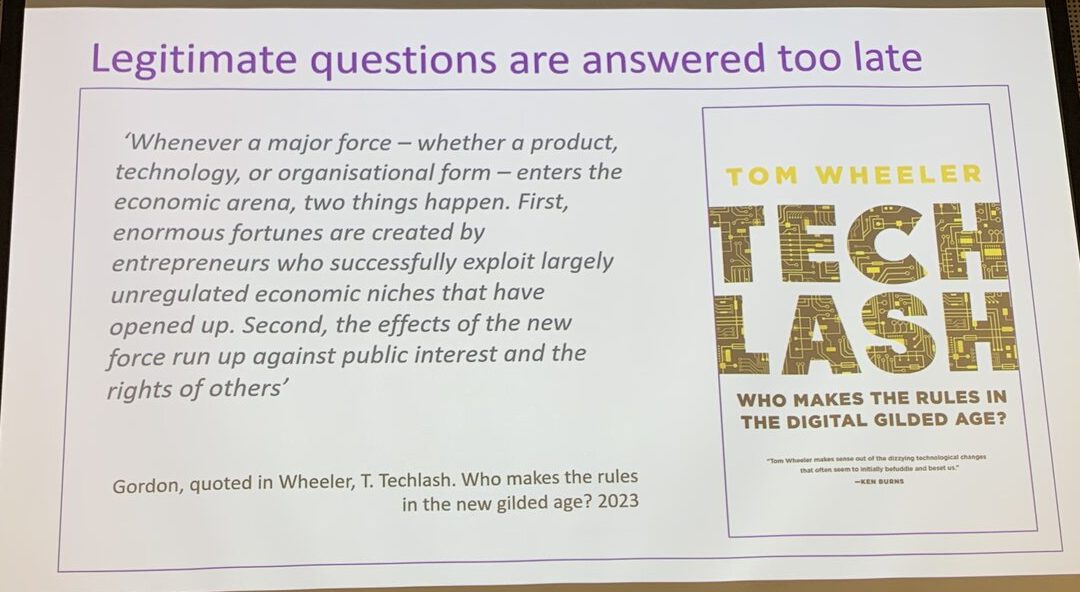
“Legitimate questions are answered too late” — the pattern Tom Wheeler documents in Techlash: fortunes are made in unregulated niches before the public interest catches up. Slide: Dame Juliet Gerrard.
Gene editing is perhaps the clearest local case study. Legislation from the 1990s tried to regulate tools rather than products, making it nearly impossible to distinguish between outcomes that are scientifically identical but legally worlds apart. The Royal Society produced excellent, policy-ready reports. A minister committed to a review. Both major parties supported change. And yet years later the legislation had gone nowhere — stalled by coalition politics, electoral cycles, and the sheer weight of the legislative queue.
We see the same dynamic in waste-to-resource technology, where the Waste Minimisation Act 2008 provides a workable legislative vehicle but the regulatory culture still defaults to the status quo. Every year of delay is another year of rising landfill levies, escalating ETS obligations, and commercial opportunities flowing to countries with more agile settings. That isn't caution. It's opportunity cost — and at Alimentary we've felt it acutely.
When does science advice actually land? The consensus quadrant
The most useful framework of the evening — and the one that has stayed with me — is the consensus quadrant, referenced on the night to Pielke (2007). It maps two axes: the degree of scientific consensus around a topic, and the degree of values consensus across the public and political landscape.
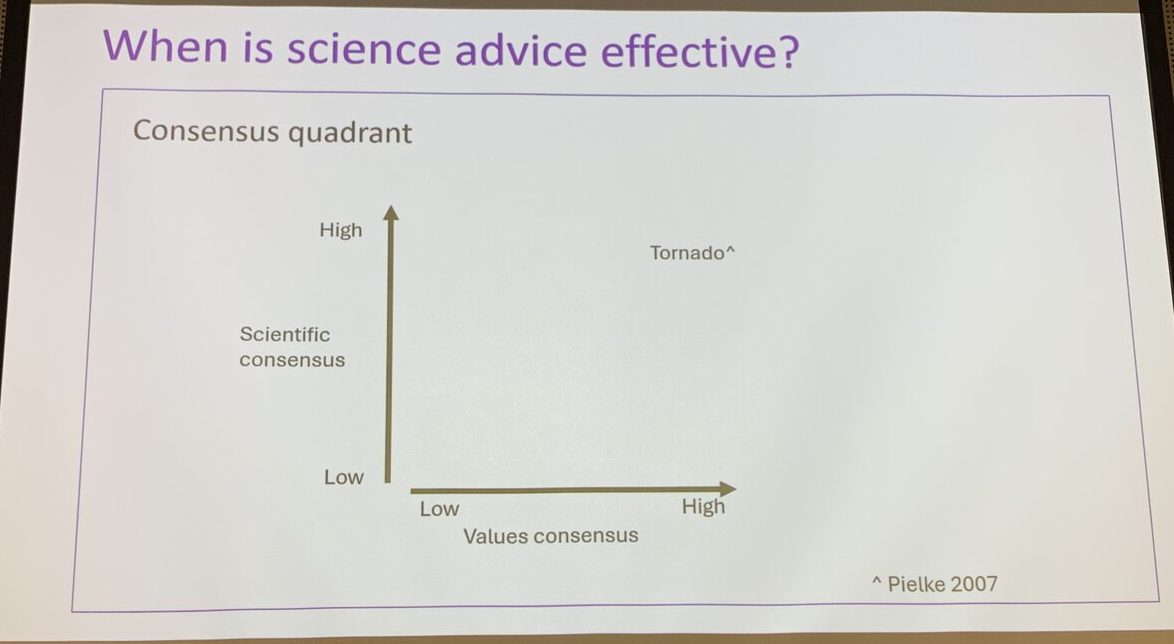
The consensus quadrant, referenced to Pielke (2007): scientific consensus on one axis, values consensus on the other. Slide: Dame Juliet Gerrard.
The insight is simple but powerful. When both scientific and values consensus are high — emergency response, say, or medical applications of new biotechnology — technical advice lands well, policy moves, and things get done. People agree on the problem and the evidence points clearly toward solutions. That's the top-right quadrant: the sweet spot.
When values consensus is high but scientific consensus is low, people are all ears but nobody knows quite what to do. When scientific consensus is high but values are deeply divided, offering technical advice is largely futile, because the argument is about values, not evidence. And in the murky bottom-left corner, where both are low, technical input tends to get weaponised by both sides.
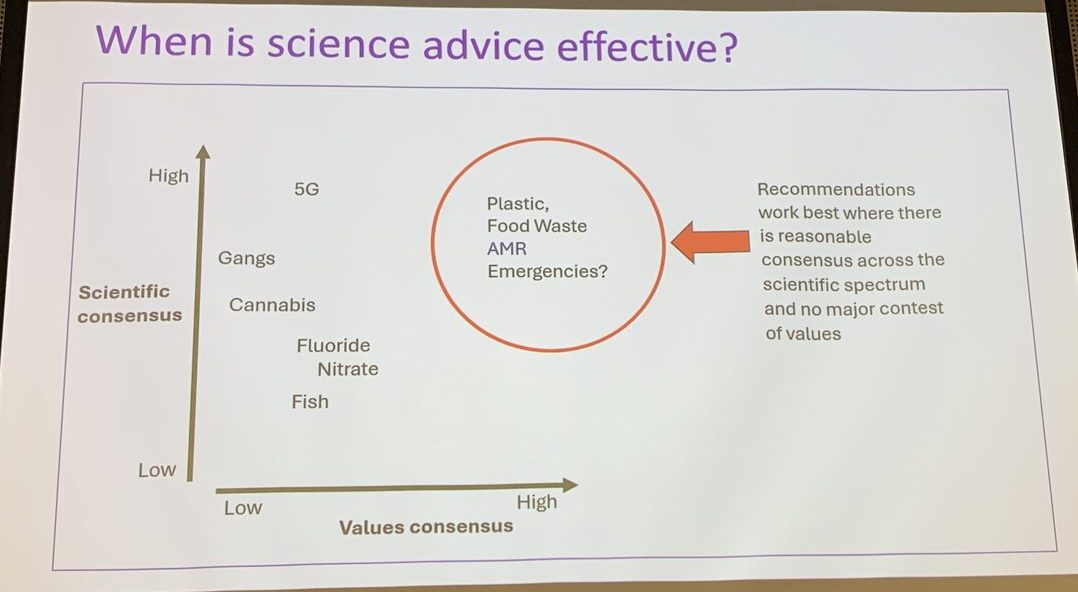
New Zealand policy topics mapped onto the quadrant. Plastics, food waste, AMR and emergency response land in the circled sweet spot; cannabis, fluoride, nitrate and fisheries sit in far more contested territory. Slide: Dame Juliet Gerrard.
The evening mapped a range of New Zealand policy topics onto the quadrant — plastics, food waste, antimicrobial resistance, 5G, gangs, cannabis, fluoride, nitrate, commercial fisheries — and the pattern was striking. The issues that moved furthest and fastest were the ones sitting in the sweet spot: high scientific consensus, high values consensus, and advice that arrived just ahead of the policy agenda.
The plastics success story
Plastics reform was the standout example. Industry was onside. The public ranked it as a top environmental concern. The legislative framework already existed. A minister with responsibility for waste was actively looking for progress. And the Chief Science Advisor's office had built deep enough relationships with officials at the Ministry for the Environment that the recommendations and the ministry's advice on those recommendations landed on the Cabinet table at the same time, rather than triggering the usual multi-month feedback loop. The result was Cabinet approval and implementation inside a single legislative cycle.
The contrast with gene editing could not be sharper. Same quality of evidence. Same calibre of experts. But that debate sat in contested values territory, on a policy agenda nobody in the Beehive wanted to touch. Result: years, multiple governments, no legislation.
Timing: just ahead of the policy agenda
The most effective science advice was consistently delivered just ahead of the policy agenda — not on it, where the decisions are already being made, and not years ahead of it, where nobody with a ministerial portfolio yet cares. The sweet spot is being ready with policy-grade evidence at the moment the political window opens.
That has direct implications for how a company like Alimentary times its engagement. There's no point knocking when nobody's home. But when the conversation is starting — when levy escalation is biting, when consents are expiring, when councils are writing their Long-Term Plans — being ready with a fully developed, evidence-backed solution is what matters.
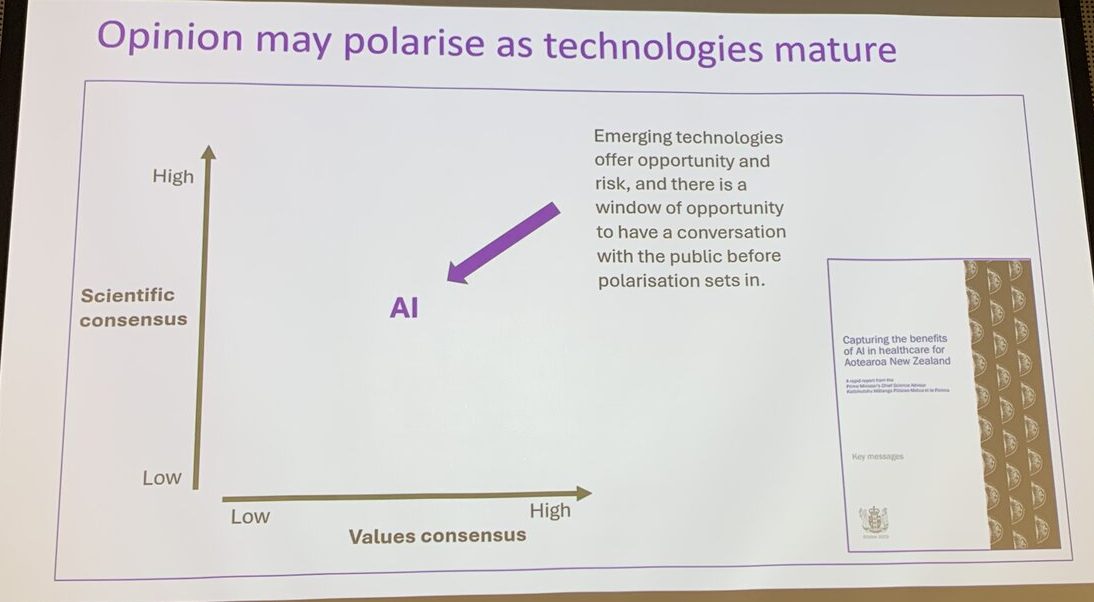
“Opinion may polarise as technologies mature” — the arrow points away from consensus, not toward it. There is a window to have the conversation with the public before polarisation sets in. Slide: Dame Juliet Gerrard.
Where does the BRRP sit on the quadrant?
This is where the framework becomes directly relevant to what we're building.
Waste — specifically what to do with sewage sludge, organic waste, and the mounting liabilities councils face as landfills close and levies rise — sits in a genuinely favourable position on both axes. The scientific consensus around anaerobic digestion, biogas recovery, and circular nutrient systems is mature. These aren't speculative technologies. The biological processes are understood, the engineering is proven, and the outputs — biogas, bio-fertiliser, carbon credits — are measurable and bankable.
On the values side, New Zealanders consistently rank waste and environmental degradation among their top concerns. Councils are under real operational pressure. There is no organised opposition to turning waste into energy and soil nutrients the way there is to, say, genetic modification of food crops. The social licence is there. The legislative vehicle is already in place. And the policy agenda has shifted decisively toward circular economy outcomes and emissions reduction.
Where the BRRP sits: high scientific consensus around anaerobic digestion and biogas recovery, high values consensus around waste reduction. Our redraw of the framework, with Alimentary's own position added — the underlying quadrant is Pielke (2007), as presented on the night.
The BRRP — our patented six-stage biological resource recovery platform — sits in exactly that alignment. High scientific consensus. High values consensus. A ready legislative pathway. And a problem that gets more expensive every year it goes unsolved.
But claiming the sweet spot is easy. What matters is whether the claim survives scrutiny.
The legislative alignment behind that position
What separates a genuinely well-positioned technology from one that merely feels well-positioned is the depth of alignment with legislation that already exists. The BRRP doesn't need new law — the architecture is already there, across several overlapping frameworks.
| Legislation / policy | Alimentary alignment | BRRP value stream | Consensus axis |
|---|---|---|---|
| Waste Minimisation Act 2008 | BRRP diverts organic waste from landfill. Every levy escalation improves the economics. | Gate fees, levy avoidance | Values + science |
| NZ ETS | Captures methane otherwise released from landfill or open lagoons. Every tonne diverted is avoided ETS exposure plus potential verified credits (ACM0022). | Carbon credits | Science |
| NPS Freshwater 2020 | Processes sludge into stabilised bio-fertiliser, replacing the discharge pathway with circular nutrient recovery. | Bio-fertiliser, consent compliance | Values |
| IFF Act 2020 | A direct financing pathway via SPVs. Councils fund waste infrastructure without competing with rate-funded priorities. | Project finance structure | Values + science |
| Government Procurement Rules (5th ed.) | A minimum 10% weighting for broader outcomes. Alimentary is NZ-founded and NZ-domiciled, delivering local employment, emissions reduction, and community waste solutions at once. | Procurement advantage | Values |
| Climate Change Response Act (amended) | Waste is a named Emissions Reduction Plan sector. Alimentary submitted to ERP2. The BRRP directly reduces biogenic methane. | Carbon credits, policy alignment | Science + values |
| UNFCCC Article 6 | Articles 6.2 and 6.4 open international markets for verified waste-sector reductions. BRRP carbon output is tradeable beyond New Zealand via ITMOs. | International carbon revenue | Science |
| Council WMMP and LTP cycles | Multiple councils are in WMMP review and the 2027–37 Long-Term Plan round simultaneously. Consent expiries on sludge lagoons are creating urgent replacement demand. | Pipeline timing | Values |
| Biosecurity Act / ACVM Act | The compliance pathway for bio-fertiliser is defined. Safety assessments, crop trials, and Digestate Accreditation Scheme work are underway. | Bio-fertiliser to market | Science |
The value proposition on our solutions page maps these settings to commercial outcomes for each customer segment. For councils, liability becomes asset: disposal fees, levy exposure, and emissions out; biogas energy, Class A output, and recovered nutrients in. For food and beverage processors, cost becomes profit. For agriculture, the nutrient loop closes. Each of those shifts is underwritten by the legislation above. The BRRP doesn't create the demand — the legislation does. The BRRP is the mechanism that lets councils and operators respond to it.
AI and the Long-Term Plan
One other thread is worth pulling on. The evening placed AI mid-quadrant, with an arrow pointing away from consensus — the warning being that opinion polarises as a technology matures, and there is a closing window to shape the conversation before that happens. But there's a specific application of AI that sits much further into the sweet spot than the general debate suggests: AI for council infrastructure planning.
New Zealand's 78 local authorities each produce a Long-Term Plan on a three-year cycle — a 10-year document that locks in infrastructure priorities, capital budgets, and service levels. Councils are working on the 2027–37 round right now, with consultation documents due out in the first half of next year. The Auditor-General's commentary on the previous round pointed to councils struggling to balance infrastructure deficits against ratepayer affordability, and nothing about that has become easier. They are now being asked to model scenarios they've never had to consider before: climate adaptation costs, freshwater and wastewater compliance pathways, waste diversion mandates, and the interplay between all of them.
This is exactly the kind of problem AI can help with — not the existential, values-laden AI debate, but scenario modelling, cost projection, and infrastructure optimisation at a scale and speed human teams alone cannot match. For Alimentary the opportunity is specific: helping councils model the total cost of waste infrastructure options — landfill versus composting versus anaerobic digestion — across the full planning horizon, accounting for levy escalation, ETS exposure, consent expiry timing, and revenue from biogas, fertiliser, and carbon credits. When a council can see the 10-year cost trajectory of doing nothing against deploying a BRRP, the business case makes itself.
By the evening's own framework, this application sits far better than the general AI debate. The science of infrastructure cost modelling is well established. Nobody opposes better-informed council decision-making. And the timing is exact: the plans are being written now.
The danger of being too far ahead
The discussion carried an important warning, though. Being in the sweet spot is necessary but not sufficient. Timing matters just as much as positioning.
Gene editing is the cautionary tale. The science was strong. The reports were policy-ready. Both major parties supported change. A minister publicly committed to a review. And still no legislation — because the issue ran ahead of where the political system was willing to go. Coalition dynamics shifted. A junior partner saw an opportunity in opposing the change. The agenda moved on, and years of expert panels, consultations, and ministerial briefings reset to zero.
The lesson is sobering: even with strong consensus on both axes, if you're pushing the system faster than it can absorb, you risk the same fate. Plastics succeeded because the advice arrived at the moment the system was ready.
Where does Alimentary sit on that timing axis? Councils are not contemplating waste diversion as a future aspiration. The pressure is already on their desks.
There's a second dimension here. Emerging technologies have a closing window — a period where public opinion is forming but hasn't yet hardened. For waste-to-resource technology there's a useful asymmetry: nobody is against turning waste into energy and soil nutrients. The values consensus isn't at risk of polarising, because the technology doesn't threaten anyone's identity, livelihood, or moral framework. That's structurally different from gene editing, AI, or cell-cultured meat.
The demand for waste-to-resource infrastructure isn't theoretical. Councils are facing consent expiries now, levy escalation now, and Long-Term Plan deadlines now. This is the plastics window, not the gene editing one.
Tech AND settings — not tech OR settings
One of the most damaging false dichotomies in New Zealand's environmental policy conversation is the idea that we must choose between technological solutions and systemic settings changes. You hear it in the methane debate: either we develop feed additives to reduce bovine emissions, or we reduce herd numbers — as if those were competing strategies rather than complementary ones.
The technology without the settings is a stranded asset. The settings without the technology is a mandate with no mechanism.
At Alimentary this is core to how we think about deployment. The BRRP is the technology. The rising waste levy, escalating ETS exposure, the IFF Act 2020 financing pathway, the Government Procurement Rules, and councils' own Long-Term Plan pressures are the settings. We need both.
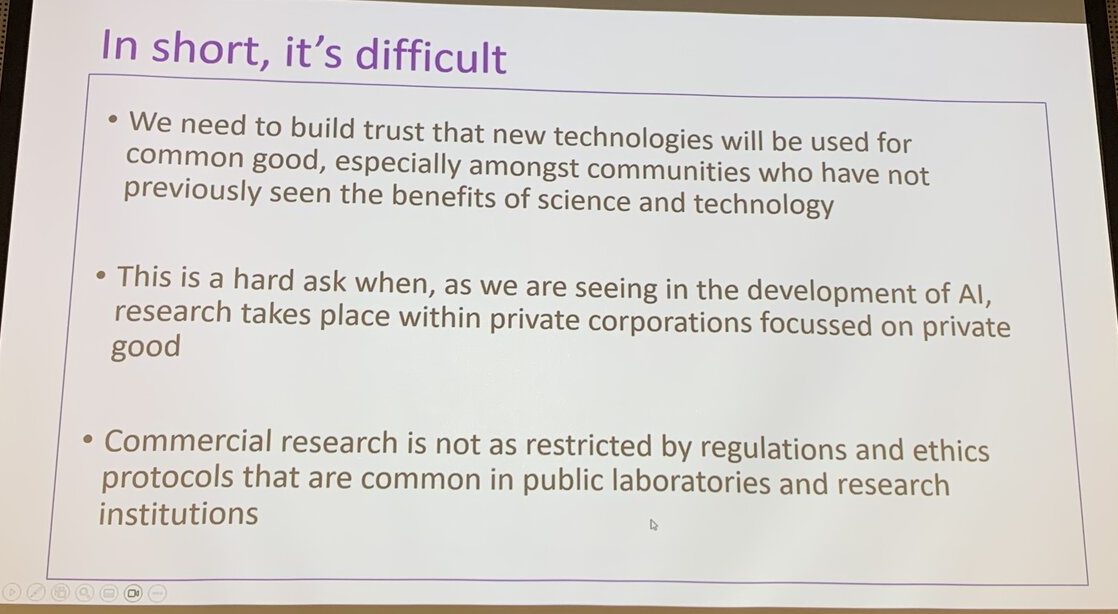
“In short, it’s difficult”: trust that new technology serves the common good is harder to build when the research happens inside private corporations focused on private good. Slide: Dame Juliet Gerrard.
The companies and researchers who understand this — who build relationships with policymakers, who shape evidence to be policy-ready, who engage with the regulatory framework rather than railing against it — are the ones who actually get new technology deployed. That's what plastics demonstrated, and it's the model we're following.
How we're applying this: stakeholder engagement
What struck me during the evening was how closely Alimentary's own engagement mirrors the approach being advocated. The consensus quadrant isn't just a diagnostic tool — it's a deployment strategy. If you're in the sweet spot, the question isn't whether to engage, but how systematically.
Between 2022 and 2026 we've built a deliberate programme spanning government, industry, and international agencies. The purpose isn't lobbying for a single outcome. It's making sure that whoever is in government, and whatever the coalition configuration, the people making decisions about waste, energy, and emissions have the evidence base they need and understand what technology is available.
It's worth being precise about what that engagement actually is, because this is exactly where companies tend to overclaim — and a list of impressive names is not the same thing as influence.
Government. Briefings, submissions and meetings with ministers, MPs and officials across National, ACT, NZ First, Labour, the Greens and TOP, along with officials at the Ministry for the Environment, MBIE, and the Parliamentary Commissioner for the Environment. The depth varies enormously. Some were substantive briefings or formal written submissions; others were a good conversation at a conference. In the past few weeks it has included Shane Jones, Minister for Resources and Regional Development, and Simon Court, ACT's climate change spokesperson.
And to be straight about the name at the top of that list: I've spoken with Prime Minister Christopher Luxon about the project once or twice — at events, and once on a plane. That's an introduction, not a mandate. I'd rather say so plainly than let it sit in a list implying something more.
Industry and sector. This is the part of the programme with the longest record, and the one we track most formally. The fertiliser work has run since March 2018 across 34 logged milestones: a research institute MoU, independent laboratory safety testing, iwi market research and relationships in Whakatū, four farm testing partnerships, crop trials in both cereals and forages, a metabolomics analysis, an emissions assessment covering both handprint and footprint, an accreditation scheme for digestate biofertiliser, and a distribution partnership. Eighteen of those milestones sit in product development and testing, ten in acceptability and industry engagement. Some of the work is under NDA with counterparties who aren't ours to name.
We manage it as a risk burn-down rather than a list of meetings, which is a more honest instrument: the assessed risk against selling a recovered-nutrient fertiliser into the synthetic market started at 0.9 in March 2018 and stands at 0.01 as of October 2025. That curve, not a contact list, is what tells us whether the engagement is working.
The timing has turned sharply in the last year, too. New Zealand applies roughly 429,000 tonnes of synthetic nitrogen annually, up more than 600% since 1990 — the fastest rate of increase in the OECD — most of it imported and all of it made from fossil gas. Between a quarter and a third of the world's traded urea moves through the Strait of Hormuz, and since the escalation in early 2026 that flow has been throttled: urea exports from the affected economies fell 83% year on year, and on 5 May Ballance lifted its urea price by $100 to $1,175 a tonne, up 110% since January. The nitrogen and phosphorus already sitting in New Zealand's sewage sludge are not shipped through anyone's strait, not priced in US dollars, and not subject to another country's export licence. We set the full argument out in Fertiliser and soil security.
International. The Global Green Growth Institute, the Asian Development Bank, the Korean Energy Agency, and the Hong Kong Monetary Authority, on carbon market mechanisms and project finance for waste-sector projects.
Why does it matter? Because political consensus can evaporate in a single electoral cycle. A change of minister can set a portfolio back years. Gene editing — where both major parties supported change and it still collapsed when coalition dynamics shifted — is a warning everyone in clean tech should take seriously.
Our cross-party approach is deliberate, because we've watched what happens when a technology's champions all sit on one side of the House. When the government changes, you start from zero. When you've engaged across the spectrum, you have continuity regardless of the election result. That's the tech-and-settings principle applied to political strategy.
Tell the story, not the spec sheet
There's a reason the most successful policy interventions start not with data tables and error bars but with a vision — a picture of what the future looks like if the recommendations are adopted, written in human terms.
The science and engineering communities, ourselves included, have historically been poor storytellers. We were selected for analytical rigour, not creative writing. We default to specifications, process diagrams, and confidence intervals. Those matter enormously in the lab and the boardroom. They matter far less when you're trying to move a minister, a council chief executive, or a community.
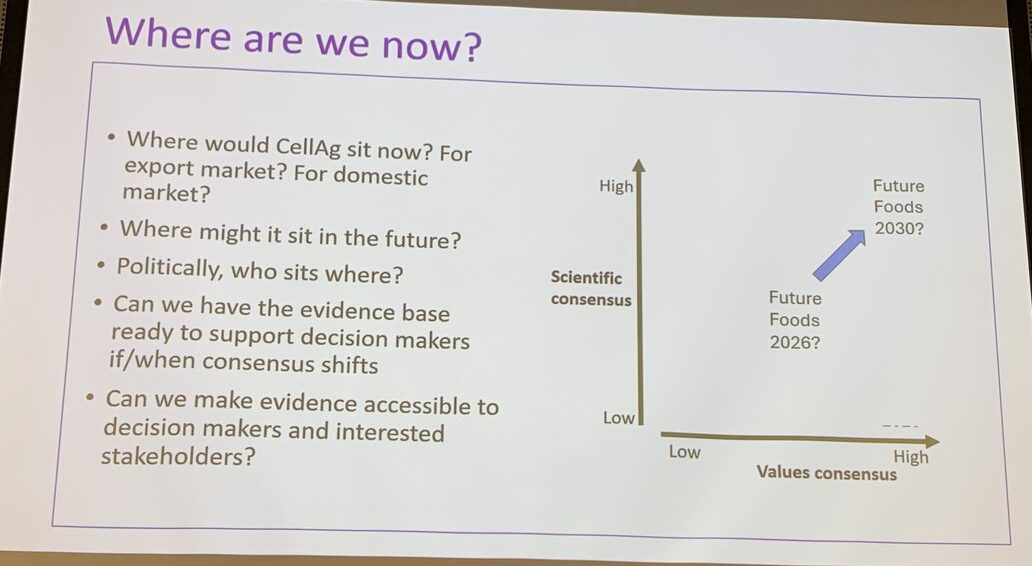
Where does cellular agriculture sit now, and where might it sit in 2030? The underlying question — can we have the evidence base ready before consensus shifts — is the one every clean-tech company should be asking. Slide: Dame Juliet Gerrard.
We've learned this the hard way and are trying to do better. When we talk about the BRRP, we don't lead with anaerobic co-digestion kinetics. We talk about a council that currently trucks sludge to a landfill closing in four years, spending more every year, with no permanent solution in sight — and what it would look like if that waste were converted on site into clean energy and certified soil nutrients, permanently, at a cost that falls rather than rises.
That's not spin. It's the same facts, told in a way that connects with the person who has to make the decision.
Scientists tend to oversell the potential and undersell the timeframe. Politicians reach for magic bullets and avoid hard settings changes. Regulators get punished more for letting a bad thing happen than for failing to enable a good one. If clean technology companies want to break through, we need to understand all three incentive structures and tell a story that works across them — grounded in evidence, honest about maturity, and clear about what it takes to get from lab to landscape.
What this means for Alimentary
I left Tech Tuesday more convinced than ever that we're building in the right quadrant. The science is settled. The values are aligned. The settings are in place, and the cost of delay is compounding for every council in the country.
But I also left with a sharper appreciation of how fragile that window is, and how important it is to be ready with policy-grade evidence, cross-party relationships, and a story that works before the political moment arrives. Not after.
Alimentary isn't just building a waste-processing technology. We're building the relationships, the evidence base, and the commercial framework that let the technology actually get deployed — because the best clean tech in the world is worthless if it can't get out of the lab.
One more thing — read the book
Dame Juliet mentioned she's spent the past year writing a book reflecting on her time as Chief Science Advisor: what worked, what didn't, and what she'd do differently. It's called Front Row Seat: How Science Can (and Can't) Shape Public Decision-Making, and it goes much deeper into the material behind the slides above.

Front Row Seat launches at Old Government House on Tuesday 15 September, introduced by Vice-Chancellor Professor Nic Smith.
- Front Row SeatJuliet Gerrard
- LaunchTue 15 Sept 2026, 5.30pm
- VenueOld Government House, 24 Princes St, Auckland
- Introduced byVice-Chancellor Professor Nic Smith
If Tuesday's talk is anything to go by, it should be a genuinely good read. She was entertaining, honest, and had the room laughing more than most comedy nights I've been to. I'm looking forward to my copy — and to the continued debate about food waste, emerging technology, and how to actually get New Zealand moving. And, on a more personal note, to working out how we're going to feed the planet when I can barely keep up with feeding my 18-year-olds.
Facing a consent expiry, a closing landfill, or a Long-Term Plan you can't cost? Talk to us about how a Bio-Resource Recovery Plant could work for your district.
Get in touch →Slide photographs reproduced from Professor Dame Juliet Gerrard's presentation Policy, Politics and Emerging Technologies, Tech Tuesday Forum, University of Auckland Newmarket Campus, 18 August 2026, with thanks. The consensus quadrant is referenced to Pielke (2007). Cover image: Photo by Adrien Olichon on Unsplash.