
Asked to name the single biggest opportunity in front of the region, Iain Hosie of the Taranaki Applied Innovation Centre did not say offshore wind. At a forum where offshore wind had dominated three sessions and a hundred conversations, he said biogas — and then, in one sentence that most of the room let sail past, he named the thing that determines whether a biogas industry actually exists or merely gets announced.
Our co-founder Matthew Jackson was at the Taranaki Energy Futures Forum in New Plymouth on Friday, convened by Jonathan Young. The afternoon innovator session was the best hour of the day, and two presentations in it — Iain's and Daniel Gnoth's — together amount to a specification for what should be built in this region. What follows is what they said, why the two halves fit together, and what it means for anyone holding a waste stream or a long-term plan.
Why an innovation centre director picks biogas over offshore wind
Iain's reasoning was regional and specific, which is what made it credible. Taranaki is already a gas region. It has the pipes in the ground. It has the gas companies. It has decades of accumulated process engineering expertise sitting in firms that are actively looking for their next thing. It has diverse organic feedstocks, many of them co-located with existing gas customers. And anaerobic digestion is a mature, well-established biotechnology that has seen substantial productivity gains overseas from new technology adoption — it is not a science project.
What the region lacks, he argued, is not the resource and not the engineering. It is the biological expertise: people working on the waste streams, scaling up co-digestion, adopting international best practice. Close that gap, he said, and Taranaki would plausibly become the biogas hub of the country and arguably of the Pacific.
He is describing a bioeconomy, not a fuel. That distinction matters enormously and it is the reason biogas gets underrated in New Zealand energy conversations. Offshore wind produces electrons. Biogas produces molecules, heat, fertiliser, carbon dioxide for horticulture, and a disposal solution for a problem every council in the country is already paying for. It is not competing with wind. It is doing a different job that wind cannot do.
Then he said this, and it is the sentence that has stayed with us ever since:
If you do not have a digestate customer and a digestate use, you do not really have a biogas industry.
Why that sentence is the whole game
Every anaerobic digester produces two things. It produces biogas, which is what everybody talks about, puts on the slide, and builds the business case around. And it produces digestate — the nutrient-rich material left over once the microbes have finished — which is what almost nobody talks about until commissioning, at which point it becomes the operator's single most expensive problem.
A digester with no digestate pathway is not a resource recovery plant. It is a very sophisticated way of relocating a waste stream. The tonnage does not vanish. It changes state and it changes address, and if there is nowhere for it to go, the facility has converted a solid waste problem into a wet waste problem with a gas engine attached.
The economics of the entire facility hinge on which of those two things you have built, because digestate is either a revenue line or a disposal cost. The swing between those two outcomes is frequently the difference between a bankable project and a stranded asset, and it does not show up in the headline gas yield that gets presented to the board.
Every digester produces two things. Only one of them gets put on the slide — and the other one decides whether the facility works.
This is precisely why the BRRP was designed the way it was. It is a six-stage anaerobic co-digestion system modelled on bovine digestion, and the biofertiliser output is not a by-product we hope to find a home for after the fact. It is one of three designed outputs alongside biogas and verified carbon reduction. The plant is built around the assumption that the residual has to be worth something to somebody, because a system that does not close its own loop has not solved anything — it has moved the problem downstream and started a clock.
Iain made the connected point through his soil science pillar. Better understanding of the region's soils, more informed decisions about crops and fertiliser use, and biofertiliser as a genuine option for Taranaki land. That is the customer, and it happens to be standing directly next to the feedstock. Dairy country with a nutrient management problem is the natural offtake for well-specified digestate. The catchment that generates the organic load is the catchment that needs the nutrients returned to it, minus the pathogens and minus the emissions.
He also noted a side stream most people miss entirely: the carbon dioxide. At one overseas operation he cited, digester CO₂ feeds eighteen acres of tomato glasshouses. That is a second revenue line from a molecule that would otherwise be vented, and it is exactly the kind of industrial symbiosis the precinct conversation was circling all day without quite landing on.
The modelling says two plants, north and south
Daniel Gnoth presented the other half of the picture, and it is the half that turns a good idea into a site. Working with the bioeconomy institute during his time at Ara Ake, he led modelling that swept the entire region, ingested every available organic feedstock, and asked a deliberately simple question: how much energy is actually here, and where would viable plants sit?
The model ran thousands of scenarios. It kept returning the same answer. Two bioenergy plants — one in the north of Taranaki, one in the south. In the north, the precise siting shifted depending on which criteria were weighted. In the south, it landed in more or less the same spot every time, if you were genuinely going to use everything that is there.
A second scenario, configured before Ara Ake's closure and looking instead at how to move organic material around the region as efficiently as possible, produced the same shape. Two depots. Two nodes. The preliminary results, he said, looked much the same as the first run.
He was refreshingly honest about the limits. There are enough organic resources in the region to do useful work, but not enough to build an export industry on. And the real question, he stressed, is not how much is there. It is who needs it, who is going to do the work, and which industries actually have to transition. The model exists and still sits there; what it needs is funding to run the next configurations. Further central government money for feedstock validation is on its way.
He also said something about the nature of this work that anybody trying to develop bioenergy in New Zealand should tattoo somewhere visible. The technical modelling is not the hard part. The hard part is the understanding of what the use cases actually are and how to make the thing work in practice — and that is a thousand cups of tea, not a thousand simulations.
What the two presentations say when you put them together
Independent modelling identifies two viable bioenergy nodes in Taranaki, north and south, robust across thousands of scenarios and across two different optimisation questions.
Independent regional expertise identifies digestate offtake as the binding constraint on whether those nodes ever get built, and identifies Taranaki soils and pasture as the natural destination.
Those are two halves of a single specification: co-digestion at regional scale, sited near grid and pipeline, with a designed nutrient return pathway into local land. It is, as it happens, exactly what we build.
The national numbers that make the regional case
Iain cited Gas New Zealand's position that biomethane could supply a substantial share of the country's natural gas needs by 2050, and made the point that the value is not only the price of the gas.
The published Gas NZ Biomethane Strategy and Action Plan puts the systemwide benefit at approximately $61 million per petajoule. Five petajoules by 2035 — the strategy's near-term target — represents roughly $305 million a year to the New Zealand economy. The 2050 ambition is 25 petajoules. Biomethane carries around 65 per cent lower emissions than natural gas, and the strategy assigns an energy security value of $25.56 per gigajoule, which is the number that gets interesting every time a tanker is delayed or a field declines faster than forecast.
Those figures matter in Taranaki in a way they do not matter anywhere else in the country, because Taranaki has the pipeline network to move the gas and the industrial load to burn it. Everywhere else, biomethane needs infrastructure built to carry it. Here, the infrastructure is already in the ground and is currently forecast to carry declining volumes. That is a stranded asset in one framing and a ready-made distribution network in another.
It also lands against a hard regional backdrop. Will Thorp of Kākāriki Renewables put up a gas production forecast during the afternoon showing the step down in 2027 as the Maui field closes, and made the case that this energy has to be replaced. Mayor Phil Nixon told the morning session that New Zealand still needs sustainable natural gas for years yet to support a secure and orderly transition. Both things are true. Biomethane is the molecule that lets them both be true at once, because it uses the existing network to deliver a lower-emissions gas into the same industrial burners.
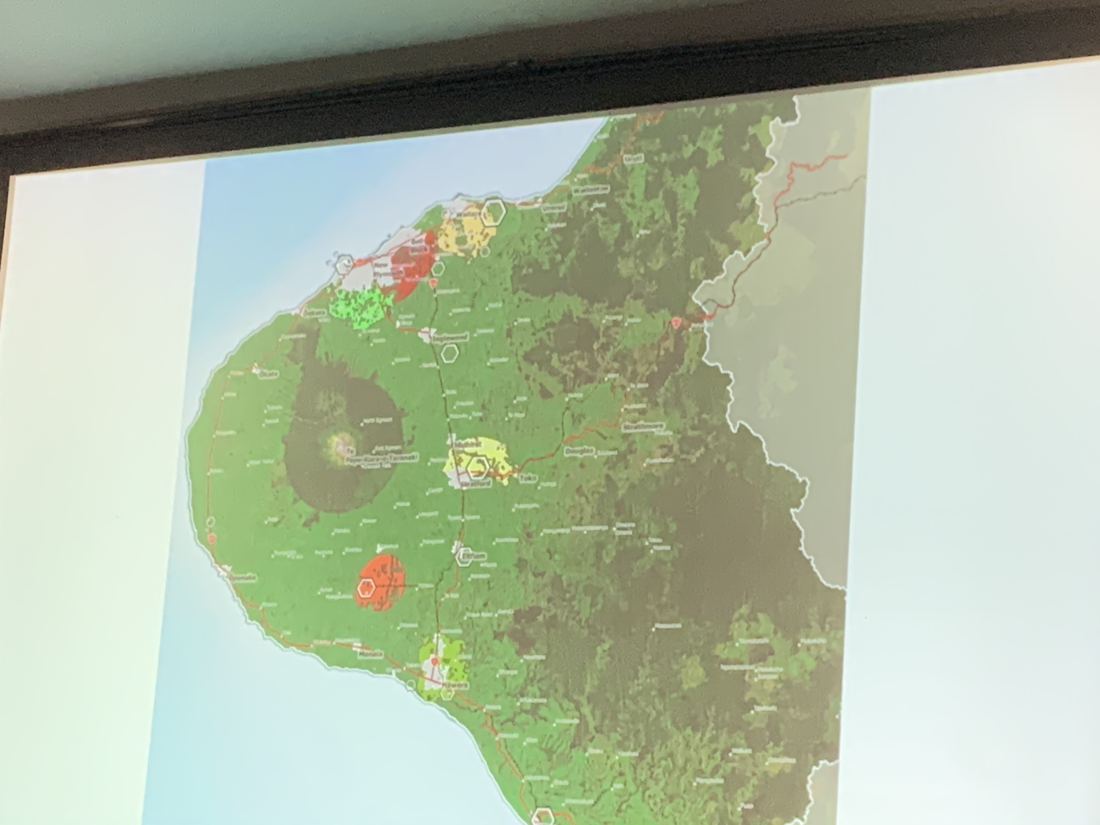
The precincts map. Six candidate areas across the region, scored on grid access, transport, industrial clustering and water availability — the evidence base a hearing panel needs and a hunch cannot provide.
Which brings us to a conversation in a corridor
Between sessions our co-founder Matthew Jackson ended up standing with South Taranaki District Council, laptop balanced on one forearm, going through numbers.
The arithmetic is uncomfortable, and it is not unique to that council. You pay a gate fee. You pay for the trucks. You pay for the diesel, and diesel is not getting cheaper. And you carry an emissions liability that grows every year the material stays in the system — a liability that has to be modelled into a long-term plan running out thirty years, on carbon price assumptions that were set before anybody knew where the carbon price was heading.
A cost that escalates with diesel and with carbon is not a cost. It is an exposure. And it sits in a plan that has to be defended in public every three years.
When a council evaluates a waste proposal, the comparison is usually narrow: what does this cost per tonne, against what we pay now. That framing almost always favours the status quo, because the status quo's costs are dispersed across half a dozen budget lines, several activity groups and three decades. Nobody ever sees them added up.
The comparison we bring to councils is deliberately wider. The disposal cost that stops. The transport cost that stops. The emissions liability that stops accruing and starts reducing. The energy sold rather than bought. The biofertiliser returned to land in the district rather than nutrients imported into it. And the money that stays inside the regional economy instead of leaving on a truck.
Run that way, the numbers move a long way. For South Taranaki we have modelled the whole system and the outcome is a material per-resident saving and a substantial sum retained in the region rather than exported with the waste.
The specific number matters less than where it came from. It was built from the council's own long-term plan data, not from our brochure. That distinction is the entire reason the conversation went anywhere.
One system instead of three contracts
The other thing that surfaced in that corridor is fragmentation. Councils typically hold separate arrangements for biosolids, for food and green waste, and for municipal solid waste. Three streams, three contracts, three fleets, three sets of assumptions, three renewal dates that never align.
A BRRP is a co-digestion system, which means the organic streams go through one plant together — sewage sludge alongside food waste and other organics. Alongside our solid waste technology partner, that covers what a council currently manages under three separate headings, including the landfill nuisance issues that consume operational attention out of all proportion to their line in the budget.
Consolidation is not merely tidier. It changes the capital case, because one facility processing multiple contracted streams has a materially better utilisation profile than three arrangements each carrying its own overhead and its own idle capacity. The waste, water and energy pressures now converging are real and measurable, but they are not why a chief executive signs. The financial case is why they sign. The environmental case is why the community supports it.
Where the plant goes, and why the regional council just did everyone a favour
Later that afternoon Finbar Kiddle, Strategy Lead at Taranaki Regional Council, presented the WSP energy precincts study. It is arguably the most immediately useful piece of work any New Zealand region has produced for infrastructure developers this year, and not enough people in the room realised what they were being handed.
The study weighted four criteria across the whole region using GIS analysis. Grid access carried the heaviest weighting — proximity to a transmission line, to a substation above a threshold value, or to available capacity in the Powerco network. Then access to transport infrastructure: state highways, railways and gas pipelines, on the straightforward logic that proximity reduces transport cost. Then industrial clustering, on the rational basis that these facilities belong where symbiotic activity already exists, near existing industrial zoning and large energy users. Then water availability, assessed both by distance to reticulated supply and by how allocated each catchment already is — and some Taranaki catchments are over-allocated. That last criterion was weighted lightly, because much of what happens in an energy precinct is not water-hungry, though hydrogen very much is.
Six candidate areas rose to the top, scoring closely to one another. Finbar was disarming about the criticism he expected: that the map simply points at the places everyone already assumed, the ones with the big existing facilities. His answer is exactly why the work matters. You cannot walk into a hearing, or the Environment Court, and say you had a feeling this should go here. The GIS analysis builds the evidence picture that a formal regulatory process demands, and it does it once, publicly, for everybody — with a public GIS portal on the way so anyone can turn the layers on and off themselves.
The four weighted criteria from the WSP energy precincts study, and how a resource recovery plant scores against each. Reproduced from the study’s stated methodology.
A BRRP scores on all four criteria, which is not a coincidence — it is what the technology is for. It needs grid connection because it generates. It needs transport access because feedstock arrives by road and gas can leave by pipeline. It belongs inside an industrial cluster because its outputs feed adjacent activity, whether that is heat, gas, CO₂ or nutrients. And its water requirement is modest compared with hydrogen, which is a genuine advantage in a region with over-allocated catchments.
Finbar's stated next step is to take the shortlist and go and talk to people — iwi, hapū, relevant landowners, relevant businesses — and find out who is interested in partnering. He was explicit that without iwi, hapū and landowner support you simply move to the next site on the list. That is the correct sequence and it is the sequence we work to.
The collective, and the gap in it
Iain announced the Taranaki Biogas Collective, currently in its infancy and drawn largely from the companies presenting that afternoon. He was explicit about who he wants in it: a gas company, a council, and organisations holding significant feedstock. The innovation centre itself plugs a real regional gap, because Taranaki has not had the lab capacity to test feedstocks or run bench and pilot-scale digestion — and he pointed out that Trojan House already has six three-thousand-litre tanks that could be converted into digesters feeding an existing gas boiler. A biogas plant, more or less, sitting there waiting to happen.
We would add one more category to his list. The collective needs somebody whose business model depends on the digestate having a home, because that is the participant who will not allow the question to be deferred to commissioning. Everybody else in a biogas value chain can live with digestate being someone else's problem. The plant operator cannot.
ASL processes sewage sludge and organic waste through co-digestion and produces biogas, biofertiliser and carbon credits from material councils are currently paying to move. The nutrient-return argument stops being abstract the moment the pipes are already in the ground and the pasture that needs the nutrients is on the other side of the fence. We would like to be at that table, and we would bring the whole-of-system analysis with us. If you are a council working on a long-term plan and the waste line is giving you trouble, here is how we configure a plant to a council waste stream — we will run your numbers before we ask you for anything.
Ngā mihi to Iain Hosie and Daniel Gnoth for the two most useful presentations of the day, to Finbar Kiddle and Taranaki Regional Council for doing evidence work that benefits every developer in the region rather than just one, and to Jonathan Young for convening the whole thing. If the biogas collective wants a foundation member who cares obsessively about what happens to the material after the gas comes off, you know where to find us.
Taranaki Energy Futures Forum — the full series
Two Hundred People, One Room, and a Region Deciding What It Wants to Be
Nobody in That Room Was Short of Money. So Why Isn’t Anything Getting Built?
Taranaki’s Biogas Moment Has a Catch, and Almost Nobody in the Room Heard It (this post)
Two Declined Consents, and What They Should Have Taught New Zealand’s Energy Sector
We Swapped One Fuel for a Whole Toolbox, and That’s Why This Feels So Hard