
On Friday, roughly two hundred people gathered at Plymouth International in New Plymouth for the Taranaki Energy Futures Forum — TEFF26, The Road Ahead. Mayors, iwi leaders, bankers, fund managers, offshore wind developers, geologists, instrument technicians, council strategists and central government. Our co-founder Matthew Jackson spent the day there. This is what happened, who said what, and why it mattered.
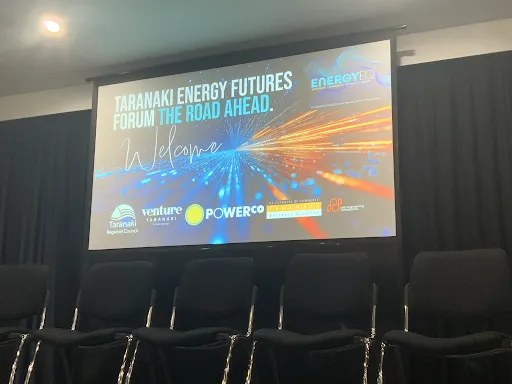
Before the doors opened. By 8.15am the room was full — mayors, iwi leaders, bankers, fund managers, offshore wind developers and instrument technicians, all in one place.
Start with the fact that it happened at all.
The organiser’s own summary of who came is worth reproducing, because the breadth is the point: energy companies, engineering and construction firms, all three Taranaki district councils and the regional council, iwi organisations, the Young Energy Professionals Network, banking and finance, the Chamber of Commerce, legal firms, central government agencies, transport companies, innovators, hospitality, consultancies, political parties, electrical companies, research institutes and community groups. That is not a sector conference. That is a region.
Ara Ake, the national new energy development centre that had convened this conversation for five years, closed in Budget 26. The Offshore Renewable Energy Forums, the Taranaki Energy Updates — the whole architecture of getting the region in one room went with it. The obvious outcome was that the conversation would simply stop, the way regional convening usually does when the institutional funding disappears.
Instead Jonathan Young picked it up and ran it anyway, through EnergyEQ, with the Taranaki Chamber of Commerce as co-host. He was open about the economics from the stage: seventy-five per cent of the ticket price went on catering and technology, and without Ara Ake underwriting it the day would land with a very small balance in the black. That is what it costs, in practice, to keep a region talking to itself.
It was worth it. Here is why.
The morning: honest about where the region actually is
Craig Williamson, chair of Taranaki Regional Council, opened with a mihi and a line that the rest of the day kept circling back to. Identify the barriers, work out how to overcome them, and then get on and do it. He also framed the question that sat underneath every session: what do we want Taranaki to look like as an energy region in ten, twenty, even thirty years — because the opportunity goes well beyond individual projects.
Phil Nixon, Mayor of South Taranaki, followed with the most sobering numbers of the morning. Industry workforce analysis indicates 1,700 full-time equivalent roles lost between 2022 and 2025 across oil and gas operators, major energy users and supporting contractors. He attributed it to falling gas production, reduced investment activity and the long-term effects of the 2018 decision to end new offshore exploration permits.
His framing of what that means was the part worth quoting. Energy decisions affect household bills, business confidence, export competitiveness, community wellbeing, and the ability of regions like this one to keep skilled people in meaningful work. And his warning: if the transition goes wrong, the cost will not be borne in Wellington.
The offshore platform technician, the process engineer, the electrical engineer and the pipe fitter are not legacy workers to be phased out. They are the people who will build and run what comes next.
Wharehoka Wano of Te Tōpuni Ngārahu spoke next, and launched the trust’s new brand publicly for the first time. His message to every developer in the room came down to one word, repeated: early. Engage early. His observation was that iwi too often find development already underway and themselves pulled in afterwards, on the back foot.
He was equally specific about what good engagement looks like, and it is not a document. The people on the ground have strong views. They may not have full information, but they will tell you exactly how they feel. You sit down, you have a cup of tea, they put bread in front of you with half a pound of butter and a lot of jam on it, and you talk about where the opportunity might land. That is the meeting.
Anne Probert of Venture Taranaki delivered the sharpest strategic framing of the morning. Energy does not create value on its own, she argued — the question is what you do with it. The region’s real opportunity is adding value to energy: attracting major users, developing products, creating industry resilience and exports. She put up a “black box” diagram showing that identical inputs can produce very different futures depending on which levers a region chooses to pull.
Dean Eggers of the Taranaki Alliance closed the session by revealing two years of quiet groundwork toward a Taranaki investment fund — owned by Taranaki, investing in Taranaki. Arun Chaudhari, chief executive of the Chamber, facilitated the panel that followed.
The best question of the day was not answered by the person it was asked of
Matthew put a question to that first panel through Slido: how do we overcome the inertia of risk when the technology to solve challenges already exists, and how can organisations address entrenched mindsets and siloed thinking? Arun read it out, then decided it deserved a second reading.
The panel gave it a fair go. But the answer landed two sessions later, from Hayden Mackenzie of Invest New Zealand, who was asked what single decision would most change Taranaki’s energy future. He did not name a project.
The biggest barrier right now is not capital and it is not projects — both are already here. We are stumbling over our own feet. Don’t skip the process; stop adding friction to it. If an answer can go back today instead of tomorrow, send it today.
That is the most actionable thing anyone said all day, and it costs nothing to act on. It is also the same diagnosis we reached writing about why good clean technology stalls on process rather than physics.
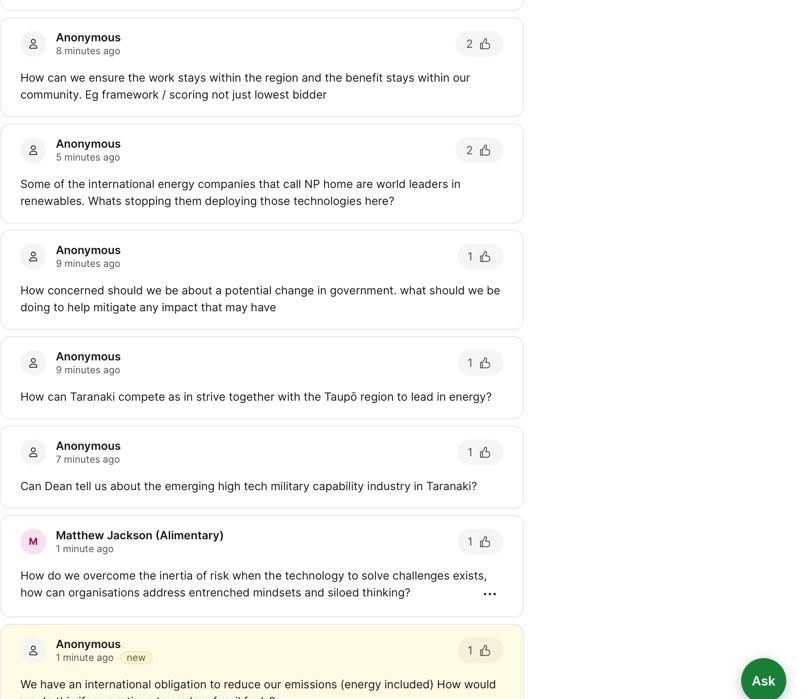
The Slido board at 9.52am. Alongside Matthew’s question: how the benefit stays in the region, why international energy companies headquartered in New Plymouth are not deploying their renewables here, and what a change of government would mean.
The money session: the constraint is not money
Session two put capital on the stage — Hayden Mackenzie, Kate Daugherty of Westpac, Ralph Chang of Motion Capital, Julie Jang of Contact Energy and Bridget Sullivan from central government.
Hayden described what he sees on the capital side: investors arriving in New Zealand with a defined thesis weighted towards energy security and decarbonisation, many deploying well beyond what the scheme requires. One, already a New Zealander, is looking to place a further twenty to thirty million into New Zealand energy with a family office behind him prepared to follow with substantially more.
Kate Daugherty gave the most practical advice of the day. New Zealanders have a powerful instinct to work things out alone and present the finished article. A good project involves a lot of people, and they should be brought in at the start rather than assembled at the end — including the bank.
Ralph Chang, whose fund has already invested in Taranaki, named the real constraint: tenor. Someone has to take the risk, and the question is whether you are comfortable with its timing and duration. Reindustrialising a region is a one-to-two-decade commitment, not a three-year hold. He also made the point that the skills built here are exportable — build the capability as a hub, take it to other regions and offshore, bring the money back in.
Julie Jang named what underwrites all of it: customers. Projects do not move without investment, investment needs certainty, and certainty comes from demand.
And Bridget Sullivan named the gap that keeps regional projects from landing in Wellington — rigorous research, impact assessment and feasibility work of the standard that convinces decision-makers. She used offshore wind as the cautionary example: Wellington kept producing objections, and the sector never assembled one comprehensive answer covering all of them. She also named the paradox underneath it. If a private operator pays for the analysis, it looks captured. If nobody pays, it does not exist.
The afternoon: environment, planning and the evidence base
Finbar Kiddle, strategy lead at Taranaki Regional Council, presented the WSP energy precincts study — a GIS assessment weighting grid access, transport infrastructure, industrial clustering and water availability across the whole region. Six candidate areas rose to the top.
He was disarming about the obvious criticism, that the map points at the places everyone already assumed. His answer is why the work matters: you cannot walk into a hearing, or the Environment Court, and say you had a feeling. The analysis builds the evidence picture a formal process demands, once, publicly, for everyone. A public GIS portal is on the way.
Dr Joshu Mountjoy of Earth Sciences New Zealand offered the day’s most useful piece of hard evidence. New Zealand has two significant non-petroleum projects tested under the Exclusive Economic Zone regime — Chatham Rock Phosphate, and Trans-Tasman Resources in the South Taranaki Bight. Both were declined. Not on technology, not on economics, but because the applicants could not demonstrate enough understanding of the environment to give the regulator sufficient certainty that effects could be mitigated.
Sera Gibson of Ngā Iwi o Taranaki connected that to capital in language an investment committee would recognise: strong local relationships and steadfast pursuit of reconciliation are the necessary building blocks for certainty and for de-risking large infrastructure investment. She also noted that in Canada, indigenous groups hold majority stakes in a large share of renewable projects, and in Aotearoa we cannot say the same — not from reluctance, but from bandwidth. What is needed is one substantial partnership landing well. She extended an open invitation to the Aotearoa Energy Summit in Ngāmotu, 12–14 October.
The innovators, who were the best hour of the day
Amelia Renzios of Hiringa Energy made the point that gets lost in transition conversations: enormous focus goes on the electrons and comparatively little on the molecules. Kapuni is the demonstration — four turbines totalling 24MW powering five megawatts of electrolysis, producing hydrogen that displaces fossil-derived hydrogen in Ballance’s urea plant. Of roughly forty-five people at Hiringa, about twenty came out of Taranaki oil and gas. Not charity, she said: those are very good skills.
Tom Wiseman and Ellie Hills of Total Instrument Services — a fellow MOA accelerator alumnus — described how their business handles a new idea. Somebody suggests something, the team asks how they would prove it, they go around the corner for parts, build it inside a week, and then they know. That habit has taken a Taranaki instrumentation firm into ISO accreditation, a metrology lab, rooftop solar, on-site green hydrogen, battery storage and its own microgeneration platform.
Iain Hosie of the Taranaki Applied Innovation Centre argued that biogas, not offshore wind, is the region’s single biggest opportunity — the pipes are in the ground, the process engineering expertise is here, and the feedstock sits next to existing gas customers. He also delivered the line of the day, about the innovation centre’s home at Trojan House, a former condom factory:
It’s all about protection — protection of our economy and protection of our environment. Some people see an old condom factory. We saw the perfect site.
The building has a waste-to-value history — it was a pharmaceutical plant turning sheep by-products into pharmaceutical products — and six 3,000-litre tanks already sit inside it that could be converted to digesters. He also noted that around half a per cent of New Zealand venture capital reaches the regions, which is the structural problem his precinct exists to attack.
Daniel Gnoth presented regional bioenergy feedstock modelling that swept the whole region across thousands of scenarios and kept returning the same answer: two viable plants, north and south. His advice to the room was to keep piloting in order to de-risk, because there is a great deal to be learned by doing.
Evelien Wallace gave the single most clarifying image of the day. We are not swapping one fuel for another; we are swapping one fuel for a multi-tool. Petrol becomes electric. Diesel becomes hydrogen or dual fuel. Jet fuel becomes SAF. Industrial heat becomes some hybrid of geoheat, electricity, biomass or biogas. Every energy need now requires a bespoke solution — which is exactly why this feels so much harder than the arithmetic suggests.
Then she explained her own position with more good humour than the situation strictly warrants. Ara Ake’s geoheat challenge is gone and she does not currently have a job — so, being a geology nerd and tenacious, she can now do what she enjoys. She is making more progress on Taranaki geoheat with no budget than most funded programmes manage with one, including finding 60°C at 40 metres in a Lepperton water bore because she talked a driller into buying a thermometer. She will trade a copy of the geoheat action plan for a coffee.
Will Thorp of Kākāriki Renewables closed with the most provocative number: New Zealand’s renewable target should not be 100 per cent of electricity, it should be around 600 per cent — three times current energy for genuine self-sufficiency, and the rest for wealth-generating industry.
How it ended
Jonathan announced the forum is not a one-off. It goes quarterly: a morning session on the last Friday in November straight after the election, then the last Friday in February, the last Friday in May, and two full days at the end of August 2027 — with longer breaks, because the corridor conversations matter as much as the stage. His phrase for why, and it should be the region’s motto:
Genius is crowdsourced.
He means it literally. In July the morning tea was crowdsourced too, and entry to the short sessions is kept free.
Dr Will Edwards closed with a karakia, and explained it first: it asks us to foster respectful relationships and to be deliberate in the work we do — deliberate listening, deliberate observing, deliberate speaking, and only then deliberate working together. That is a better description of how infrastructure actually gets built in this country than most project management textbooks manage.
Thank you to the people who made it happen
Jonathan Young and EnergyEQ, for picking this up when Ara Ake’s closure left a hole where the conversation used to be, and for committing to run it quarterly from here.
Platinum sponsors: Taranaki Regional Council, Te Puna Umanga Venture Taranaki, Powerco, the Taranaki Chamber of Commerce and Plant and Platform Engineering Consultancy. A forum like this does not happen because somebody has a good idea. It happens because organisations back the good idea with a budget.
Facilitators: Arun Chaudhari, Jonathan Young, Nick Cozens of BECA, and Dr Will Edwards.
And Victoria at the Plymouth International, who made the day run the way a well-run day does — which is to say invisibly.

EnergyEQ convened the forum after Ara Ake’s closure left the region without a host, and has committed to running it quarterly from here.
What the day added up to
Everything Taranaki needs to build its next energy economy was physically present in that building on Friday — the same pattern we saw at the Aurora Climate Tech Summit in July. The capital, the feedstock, the engineering, the consenting knowledge, the iwi partnerships, the workforce. The barrier is not any one of those things. It is coordination, sequencing, and the willingness of somebody to be first on a specific site.
That is a solvable problem, and it is solvable regionally. It does not require Wellington to change its mind first.
Over the rest of this week we are publishing four longer pieces drawing out the threads that mattered most — on investment and the inertia of risk, on biogas and the digestate problem nobody talks about, on partnership as a de-risking mechanism rather than a courtesy, and on why the transition fragmented into a toolbox. Each one goes deeper than a day-report can.
If you were in the room and we have mis-stated something you said, tell us and we will correct it. And if you are working on any of this, this is who we are — we would rather find the adjacency early. Get in touch.
Ngā mihi nui to everyone who spoke, everyone who asked a question, and everyone who travelled. See you on the last Friday in November.
Taranaki Energy Futures Forum — the full series
Two Hundred People, One Room, and a Region Deciding What It Wants to Be (this post)
Nobody in That Room Was Short of Money. So Why Isn’t Anything Getting Built?
Taranaki’s Biogas Moment Has a Catch, and Almost Nobody in the Room Heard It
Two Declined Consents, and What They Should Have Taught New Zealand’s Energy Sector
We Swapped One Fuel for a Whole Toolbox, and That’s Why This Feels So Hard