
Our co-founder Matthew Jackson spent Friday at the Taranaki Energy Futures Forum at Plymouth International in New Plymouth — a day convened by Jonathan Young after Ara Ake's closure left the region without an obvious host, and backed by Taranaki Regional Council, Venture Taranaki, Powerco, Plant and Platform, and the Taranaki Chamber of Commerce. Roughly two hundred people. Mayors, iwi leaders, bankers, fund managers, offshore wind developers, geologists, instrument technicians. By mid-afternoon he had a fairly uncomfortable conclusion written in his notebook: everything Taranaki needs to build its next energy economy was physically present in that building, and almost none of it was moving.
It is worth setting out why, because the answer the room arrived at is not the answer the sector usually gives itself.
Halfway through the morning Matthew put a question to the panel through Slido. Arun Chaudhari, the Chamber's chief executive, read it out, decided it deserved a second reading, and then read it out again:
How do we overcome the inertia of risk when the technology to solve the challenge already exists? How can organisations address entrenched mindsets and siloed thinking?
The panel had a fair go at it. Anne Probert from Venture Taranaki gave the most honest answer available to her, which was that introducing something new is hard, it costs more at first, and everybody waits for somebody else to go first and build the critical mass. She used farmers as the example: they want to see the thing working on a farm, in real time, and then the neighbour looks over the fence, and then it spreads. That is true and it is useful. But it is a description of the problem rather than a way out of it.
Jonathan came back to the question unprompted in his closing remarks — he said he wanted to carry it into the investment session — and made the point that without an appetite for risk you will never do anything new, which is precisely what a transition requires. Then he named the counterweight, and it is the sharpest thing anybody said all day about why transitions stall: move too fast and you create economic disruption severe enough to stop the transition itself. Shift the transport fleet before the alternatives are affordable and every household feels it at the checkout. New Zealand is an export economy with long, expensive supply lines; elevated input costs land everywhere at once. Lose the public and you lose the mandate, and then nothing gets built for another electoral cycle.
So there is the tension. Too slow and the window closes. Too fast and the politics collapse. Two sessions later, the investors gave the room a way through it.
The barrier is not capital, and the people with the capital said so
Session two put money on the stage: Hayden Mackenzie from Invest NZ, Kate Daugherty from Westpac, Ralph Chang from Motion Capital, Julie Jang from Contact Energy, and Bridget Sullivan representing central government. Different mandates, different risk tolerances, different time horizons. They disagreed about plenty.
Asked at the end what single decision he would most want to look back on as the moment Taranaki's energy future changed, Hayden did not name a project. He said the biggest barrier right now is not capital and it is not projects — both are already here — and that the sector is stumbling over its own feet. His ask of the room was almost startlingly modest: if you are in a position to help these projects, make life easier for them at every step. Don't skip process. Just stop adding friction to it. If an answer can go back today rather than tomorrow, send it today. Speed helps with all of this. Get out of the way and let people get on with it.
Anyone who has been through an infrastructure process knows how radical that sounds from the inside. Nobody in a consenting chain believes they are the delay. Every individual step is defensible. The friction is emergent — it lives in the aggregate, not in any one desk — which is exactly why nobody owns it and nobody fixes it.
Hayden then described what he sees on the money side, and it is worth setting out in detail because it contradicts the story New Zealand tells itself about being capital-starved. Under the Active Investor Plus programme, migrants arriving with significant capital are not simply parking the required minimum and stopping. A meaningful proportion arrive with a defined investment thesis, and that thesis is frequently weighted towards energy security and decarbonisation. He described one investor who came through an earlier iteration of the scheme, became a New Zealander four years ago, and is now looking to place a further twenty to thirty million dollars into New Zealand energy, with a family office behind him prepared to follow with substantially more if the first tranche goes well. He described another, a German private equity principal with twenty-five years of solar behind him, who looked at New Zealand and saw Germany two decades ago — and treated that as the opportunity rather than the problem. That man is now on a New Zealand board.
Ralph Chang, who noted that Motion Capital has already invested in Taranaki, framed the same market from the fund side and added the dimension that most New Zealand pitches get wrong. Someone, at some point, has to take the risk, and the real question is whether you are comfortable with its timing and its tenor. Reindustrialising a region is a one-to-two-decade commitment, not a three-year hold. Risk capital has to go into infrastructure before the returns are visible, or the infrastructure does not exist to produce them.
His sharpest framing was the one nobody wrote down at the time, because everybody was laughing. Venture capital, he said, is the Tabasco sauce. Project finance is the meat and potatoes.
A very small amount of Tabasco makes the whole thing extremely hot. Meat and potatoes is dull by comparison — and it is what the meal is actually made of.
It lands because it is an accurate description of proportion. Venture capital is a small share of the money in any built asset, and it behaves accordingly: big swings, commensurate risk, commensurate reward, and a tolerance for total loss on any given position. Project finance is the other ninety-odd per cent. It is boring on purpose. It wants contracted revenue, covenants, security, and a return that shows up on schedule for two decades.
The mistake New Zealand infrastructure promoters make is bringing a Tabasco pitch to a meat-and-potatoes room. Growth-story language, hockey-stick projections, technology novelty — all of it reads as risk to the people writing the large cheques. What they want is the least exciting document you have ever produced.
He also made a point that ought to reshape how New Zealand cleantech companies present themselves. The skills and expertise built in a region are exportable. Build the capability as a hub here, then take it to other regions and offshore, and bring the money back in. That is a fundamentally different investment case from a single-asset play, and it prices differently — because the second plant is cheaper than the first, and the tenth is cheaper again.
Capital is not the constraint. Projects are not the constraint. Both were in the building. What was missing was anyone willing to be the first mover on a specific site.
What a bank actually wants, and why almost nobody gives it to them
Kate Daugherty's contribution was the least glamorous of the day and possibly the most immediately actionable. Asked the same closing question, she said the thing that would change the trajectory is bringing the parties together early. New Zealanders, she observed, have a powerful instinct to work things out on our own and present the finished article. But a good project involves a lot of people, and they should be brought in at the start rather than assembled at the end — including the bank.
Anyone who has taken an infrastructure project to a credit committee knows exactly why this matters. A bank handed a fully-formed project it has never seen before will ask questions the developer resolved eighteen months earlier, on assumptions that are now baked into the engineering and cannot easily be re-opened. The answer is either an expensive redesign or a declined application. A bank that has watched those assumptions get made can lend against them, because it understands why each one was chosen.
There is a cultural point buried in there too. Presenting the finished article is a defensive posture. It assumes that showing someone your working invites them to attack it. In infrastructure, the opposite is true: showing your working is how you build the syndicate of people who will defend the project when it comes under pressure. And it always comes under pressure.
The offtake question, which cuts both ways
Julie Jang made the point that ties the whole session together. Projects do not get off the ground without investment; investment requires certainty; and certainty comes from customers. New demand is what underwrites everything upstream of it. She was speaking about the proposed Stratford data centre, and she was candid about its own dependencies — the resource consent is the gate to a final investment decision, and after consent you still need to get earthworks done before the Stratford rain arrives, which is excellent for cooling a running data centre and miserable for building one. Her honest answer on timing was as soon as possible, with early 2028 an aspiration rather than a promise.
Hayden agreed with the underlying logic and put it more bluntly: confirmed demand is the unlock that allows the underwriting of the energy projects behind it. For years the sector wondered what the offtake would be. Now there is at least a partial answer.
This is worth stating plainly, because it is the structural weakness in a great many renewable energy propositions circulating in New Zealand right now. Generation without contracted offtake is a merchant bet wearing an infrastructure costume. It may be a good bet. It is not the same asset class, and it should not be priced as though it were.
What “bankable” meant across the whole panel. Four criteria, four different professions, one shared conclusion.
It is also why waste infrastructure sits differently on a risk-adjusted basis, and why we keep making this argument to investors who arrive interested in generation. A Bioenergy Resource Recovery Plant does not have to go and find a customer for its feedstock. The feedstock arrives as a problem that somebody is already paying to solve, under a council's long-term plan, at volumes that are forecastable decades out because they track population rather than commodity cycles. And the outputs — biogas, biofertiliser and verified carbon reduction — each have their own demand curve. The offtake question runs in both directions, and both directions can be contracted before a spade goes in the ground.
That is not a claim that our projects are risk-free. It is a claim about where the risk actually sits. In waste infrastructure the risk is consenting, construction and counterparty. It is not demand. Demand is the one thing a council can guarantee, because the sludge arrives every single day whether anyone has made a decision or not.
The gap central government named, and it is our gap too
Bridget Sullivan was asked whether a dedicated Taranaki investment fund would make a difference — a proposal Dean Eggers of the Taranaki Alliance had floated that morning, describing two years of quiet groundwork toward a fund owned by Taranaki, investing in Taranaki. Her answer was more interesting than a yes or a no.
What she sees missing when regional projects come looking for national support is not money. It is rigorous research, impact assessment, feasibility work and comprehensive analysis of the kind that actually convinces decision-makers. She used offshore wind as the cautionary example, and it is a painful one for this region. The argument did not land where Wellington needed it to land. Wellington kept producing objections — the cable, the permitting, the regulatory regime, all the ones everybody in the room could recite — and the sector never assembled a single comprehensive answer that covered all of them at once.
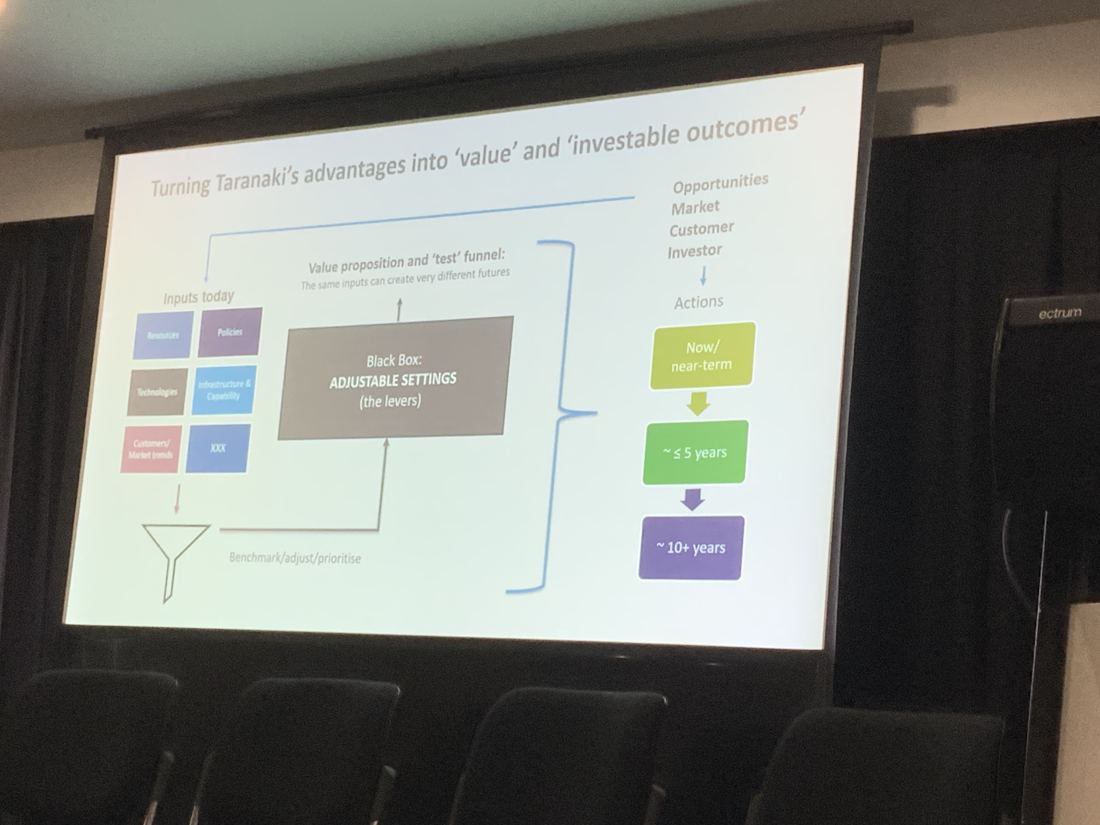
Anne Probert of Venture Taranaki on turning regional advantages into investable outcomes. The grey box in the middle is the part nobody can outsource: the levers a region actually controls, and the fact that identical inputs can produce very different futures depending on how they are set.
She also identified the funding paradox underneath it, and few people state it so cleanly. If independent analysis is paid for by a private operator, it risks being seen as captured by that operator. If nobody pays for it, it does not exist. So the analysis that would unlock the investment is precisely the analysis that nobody has a clean incentive to fund. Her suggestion was a regionally-based collective source that could fund genuinely independent work — and she conceded that no obvious source currently exists.
What "bankable" meant across the whole panel
A real customer with real offtake. Contracted, not projected. Julie Jang's point, and Hayden Mackenzie's.
Analysis that survives a sceptical outside reader. Not a feasibility study written to justify a decision already taken. Bridget Sullivan's point.
Financiers engaged from the start. Not handed a finished article at the end. Kate Daugherty's point.
A promoter who understands the tenor. Patient money, priced for a one-to-two-decade horizon. Ralph Chang's point.
Not one of these is a technology question. Every one of them is a question about how the project was assembled.
The organisations moving fastest had not eliminated risk. They had reduced the cost of being wrong, which is a design choice rather than a personality trait.
What breaking the inertia actually looks like
The best counter-example of the day came from the afternoon innovator session, and it came from a company nobody would describe as a disruptor.
Tom Wiseman and Ellie Hills from Total Instrument Services — formerly Taranaki Instrument Services, renamed as their work spread beyond the region — described how their business handles a new idea. Somebody suggests something. The team sits around a table and asks how they would prove it. They walk around the corner to the junction for parts, build the thing inside about a week, and then they know whether it is any good.
Tom bought into the company two weeks before the first COVID lockdown, which he described with admirable understatement as a rocky start. Since then that habit has taken a Taranaki instrumentation and electrical firm from servicing oil and gas sites into ISO accreditation for quality and health and safety, a metrology calibration lab to international standards, a rooftop solar array, on-site green hydrogen production, battery storage, and a microgeneration retail platform of their own. Not through a hundred-million-dollar programme. Through building things and finding out.
Ellie made the point that matters most. It is small scale, and for them that is the entire point: it proves the concept, it is immediately commercialisable, it uses skills they already have, and it gives apprentices somewhere to cut their teeth now that the pathway into the big oil and gas operators has closed.
Daniel Gnoth arrived at the same conclusion from the modelling side. Presenting the regional bioenergy feedstock work he led during his time at Ara Ake, he told the room to keep piloting in order to de-risk and to understand what is possible — because there is a great deal to be learned by doing and by demonstrating, and the region now has enough momentum, skills and knowledge to lean into it. Modelling still has to happen. It does not substitute for a plant in the ground.
Every organisation at that forum which had moved fast had done the same thing. Not eliminated risk — reduced the cost of being wrong.
That is the pattern, and it is a design choice rather than a personality trait. Reduce the cost of being wrong and you can afford to try things. Keep the cost of being wrong catastrophically high and every rational actor in the chain waits for someone else to move first — which is the precise definition of the inertia Matthew asked about.
It is available to councils and investors just as readily as it is to engineering firms. A council that phases a commitment, or contracts for a defined tonnage rather than a whole waste strategy, has reduced the cost of being wrong. An investor who funds a first plant with a defined pipeline behind it has done the same. None of that requires anyone to be braver. It requires the structure to be different.
Where this leaves us
ASL came to Taranaki with the analysis already done. Not a brochure — whole-of-system costings for the region's waste streams, built from councils' own long-term plan data, showing what the region currently spends to send material away and what it would keep if that material were processed here. That work is the thing Bridget Sullivan said was missing, and she is right that it is the binding constraint. We have done it because nobody else was going to, and because a council chief executive cannot advocate for something they cannot evidence.
The technology question is settled and has been for years. Anaerobic digestion is a mature biotechnology with decades of global operating history. we have written before about how good technology stalls on policy rather than physics is modelled on bovine digestion, which is about as thoroughly field-tested a system as biology offers. The reference plant has been running since 2021. Nobody is being asked to believe in a breakthrough.
What is being asked is harder, and it is exactly what Ralph described: for somebody to be comfortable with the timing and the tenor of the risk, and to go first on a specific site with a specific council. After that it gets easier, because the second plant is not a leap of faith. It is a reference.
The honest reflection on the day is that Taranaki does not have an energy problem. It has a coordination problem wearing an energy problem's clothes. The skills are there — roughly twenty of Hiringa's forty-five people came out of Taranaki oil and gas, and half the room knew someone who had left the region because the work dried up. The feedstock is there. The infrastructure is there. The capital is there, and it is looking. What is missing is the willingness to be first, and the structures that make being first survivable.
If you are a council, an investor or a site holder wondering what your organic waste stream is actually worth, what international investors say they actually look for — and we would genuinely rather run your numbers than pitch you. Come and have that conversation with us.

EnergyEQ convened the forum after Ara Ake’s closure left the region without a host. Intelligence, connectivity, alignment, delivery — on Friday it was mostly connectivity, and that turned out to be the point.
A postscript on why this one mattered
Jonathan closed by announcing that the forum is not a one-off. It moves to quarterly: a morning session on the last Friday in November, straight after the election, then the last Friday in February, the last Friday in May, and a full two days at the end of August 2027. Less compressed than this one, with longer breaks, because the connections made in the room between sessions are at least as valuable as anything said from the stage. His phrase for it was that genius is crowdsourced, and he means it literally — in July the morning tea itself was crowdsourced, and entry to those sessions is kept free.
He was also candid about the economics. Seventy-five per cent of the ticket price for Friday went on catering and technology. Without Ara Ake underwriting it, the day will land with a very small balance in the black. That is what running a regional convening function looks like once the institutional support disappears, and it is worth saying out loud, because the alternative to Jonathan doing this is that nobody does.
Ngā mihi nui to Jonathan Young for picking this up after Ara Ake's closure left a hole where the conversation used to happen, and to Arun Chaudhari for reading Matthew’s question out twice. To Hayden Mackenzie, Kate Daugherty, Ralph Chang, Julie Jang and Bridget Sullivan — an hour considerably more useful than most investment panels. And to the organisations who backed it with a budget rather than goodwill: Taranaki Regional Council, Te Puna Umanga Venture Taranaki, Powerco, the Taranaki Chamber of Commerce and Plant and Platform Engineering Consultancy. A forum like this does not happen because somebody has a good idea. It happens because organisations back the good idea with a budget.
Dr Will Edwards closed the day with a karakia, and it was the right note to finish on. He explained it before he delivered it: it asks us to foster respectful relationships and to be deliberate in the work we do — deliberate listening, deliberate observing, deliberate speaking, and only then deliberate working together.
That is a better description of how infrastructure actually gets built in this country than anything in a project management textbook. Listen first. Observe what is actually there. Then speak. Then build.
The next one is on all of us to make count. Last Friday in November.
Taranaki Energy Futures Forum — the full series
Two Hundred People, One Room, and a Region Deciding What It Wants to Be
Nobody in That Room Was Short of Money. So Why Isn’t Anything Getting Built? (this post)
Taranaki’s Biogas Moment Has a Catch, and Almost Nobody in the Room Heard It
Two Declined Consents, and What They Should Have Taught New Zealand’s Energy Sector
We Swapped One Fuel for a Whole Toolbox, and That’s Why This Feels So Hard