If the morning belonged to the founders, the international investor panel after lunch belonged to the people who write the cheques — and it was the most candid hour of the day about money. It was hosted by Motion Capital and moderated by its partner Lachlan Nixon, who framed the summit's whole purpose in one line: to make this "the one day in the calendar" where you can tell international investors, come down to New Zealand and you'll see the whole ecosystem. The reason it matters, he added, is blunt — many of these companies are capital-intensive, and they need follow-on investors ready to back them as they grow.
The panel he assembled was heavier than the printed programme suggested. Alongside Nixon were five funds, not two:
- Ben Lindsay — Investable, an early-stage Australian VC (≈160 investments, including Canva and SafetyCulture) who leads its climate and green-tech strategy, now based in Singapore and running Sydney's 4,500m² Greenhouse climate-tech hub;
- Roy Chng — Emerald Technology Ventures, a specialist industrial-innovation investor founded in 2000, headquartered in Zurich with offices in Toronto and Singapore, managing roughly €1.3 billion across energy, water, materials and industrial AI, backed by more than 50 multinational corporate LPs;
- Kristin Vaughan — Virescent Ventures, Australia's largest specialist climate-tech VC, spun out of the Clean Energy Finance Corporation (the country's green bank);
- Mark Frayman — Orion Industrial Ventures, the venture arm of the Orion Group (one of the largest asset managers in minerals and mining), focused on the critical minerals and materials that decarbonisation depends on.
(A note on the record: the programme listed only Nixon, Frayman and Lindsay. Vaughan and Chng joined on the day, and a live transcript garbled two names we've corrected here — "Fluorescent Ventures" is Virescent Ventures, and "Mark Freeman / Ryan Industrial Ventures" is Mark Frayman of Orion.)
Different money, different mandates
Nixon's first useful move was to draw out how each fund's backers shape what it can do — because a founder who understands an investor's constraints can save everyone months.
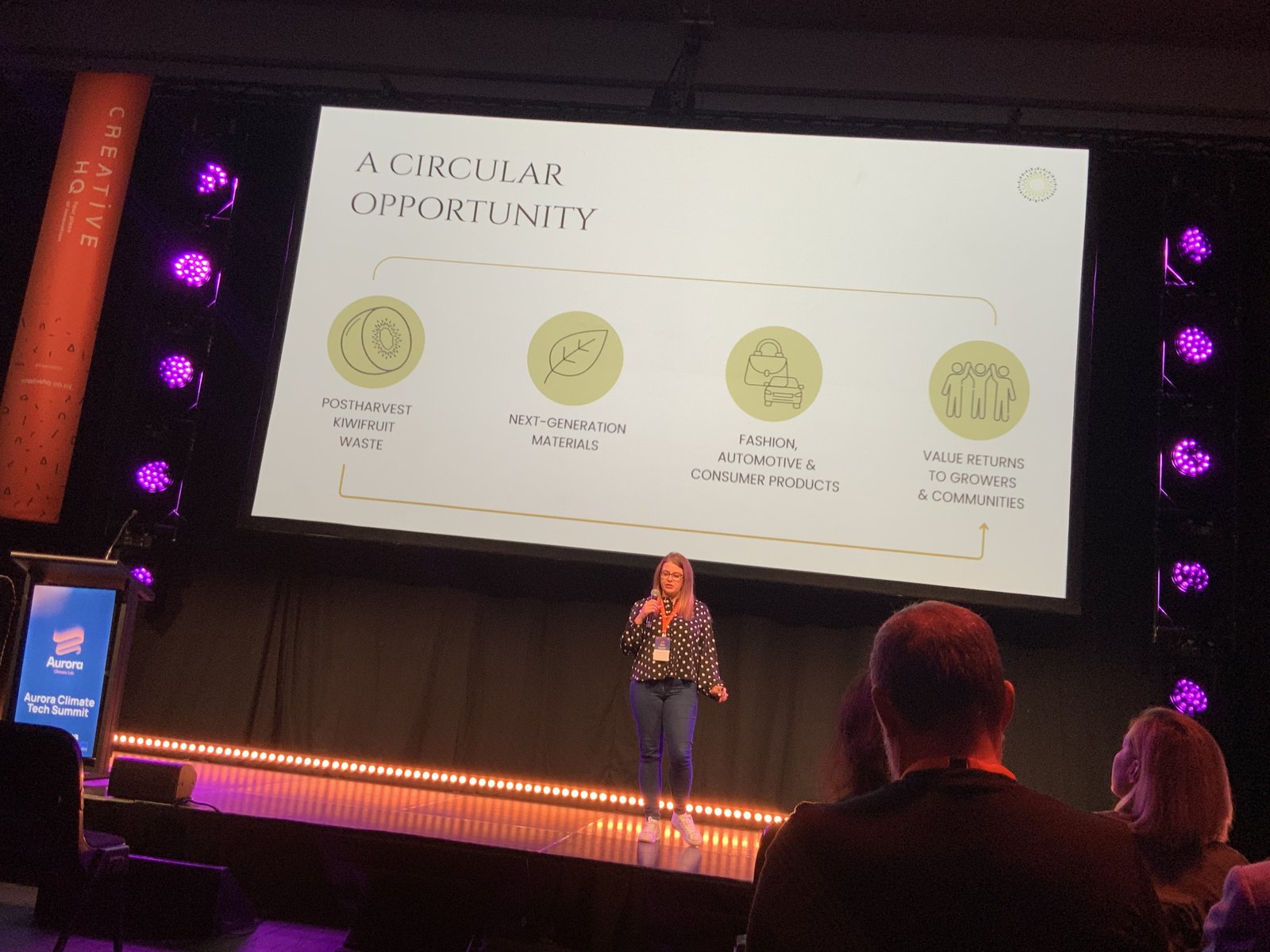
The founders under the lens: a circular-economy materials pitch from the Aurora showcase — the "cheaper, better, faster" story the panel said wins.
Virescent's cornerstone is the CEFC, which gives it deep energy expertise but a distinctly Australian centre of gravity. Vaughan's framing of the Australian market was one founders should remember: "It is a big enough market and really exciting market to test technology and learn a lot and be successful in — but it's not so big that if you make some mistakes, you blow up the world." Since spinning out, Virescent can invest globally, but the test is simple: where can it add the most value? Often that means an Australian angle — though, tellingly, she cited a Kiwi portfolio company, Quetta of Napier, whose best market turned out to be Europe, and said the fund pushed it there because "we'll always do what's right for the company."
Orion's Frayman contrasted strategic and financial investors from lived experience — he was previously at BHP Ventures. A corporate arm like BHP's opened unique deal flow and could catalyse a nascent market, he said, but it "necessarily confined the mandate" to what fitted the parent's strategy. Orion, he argued, tries to combine the best of both: invest in anything across its sector that makes financial sense, while still bringing strategic value through Orion's underlying portfolio of mining assets.
Emerald's Chng described the machinery that makes a corporate-LP fund useful to founders: a platform (Emerald calls it Inspire) that surfaces startups to its 50-plus multinational LPs, who can become co-investors, customers, or even due-diligence partners — he gave the example of a water LP offering its own test labs to trial a portfolio company's technology. It's a reminder that the right investor brings a customer Rolodex, not just capital.
Investable's Lindsay was the most colourful, and the most instructive on structure. Australia's ESVCLP regime gives his LPs generous tax treatment — but only if the companies stay Australian for a location test, which means he routinely has to pass on companies he likes but "just can't do anything with." That constraint is why Investable opened in Singapore. And he flagged a shift founders should note: with Australia's capital-gains settings tightening, some Singapore investors, he said, half-joke that "Australia is going to become Greece for them" — a nice holiday destination — while turning their sights instead toward New Zealand, drawn by exits like Rocket Lab. Singapore, he argued, is a one-step gateway to Europe and the US via investors like Emerald.
The death of the green premium
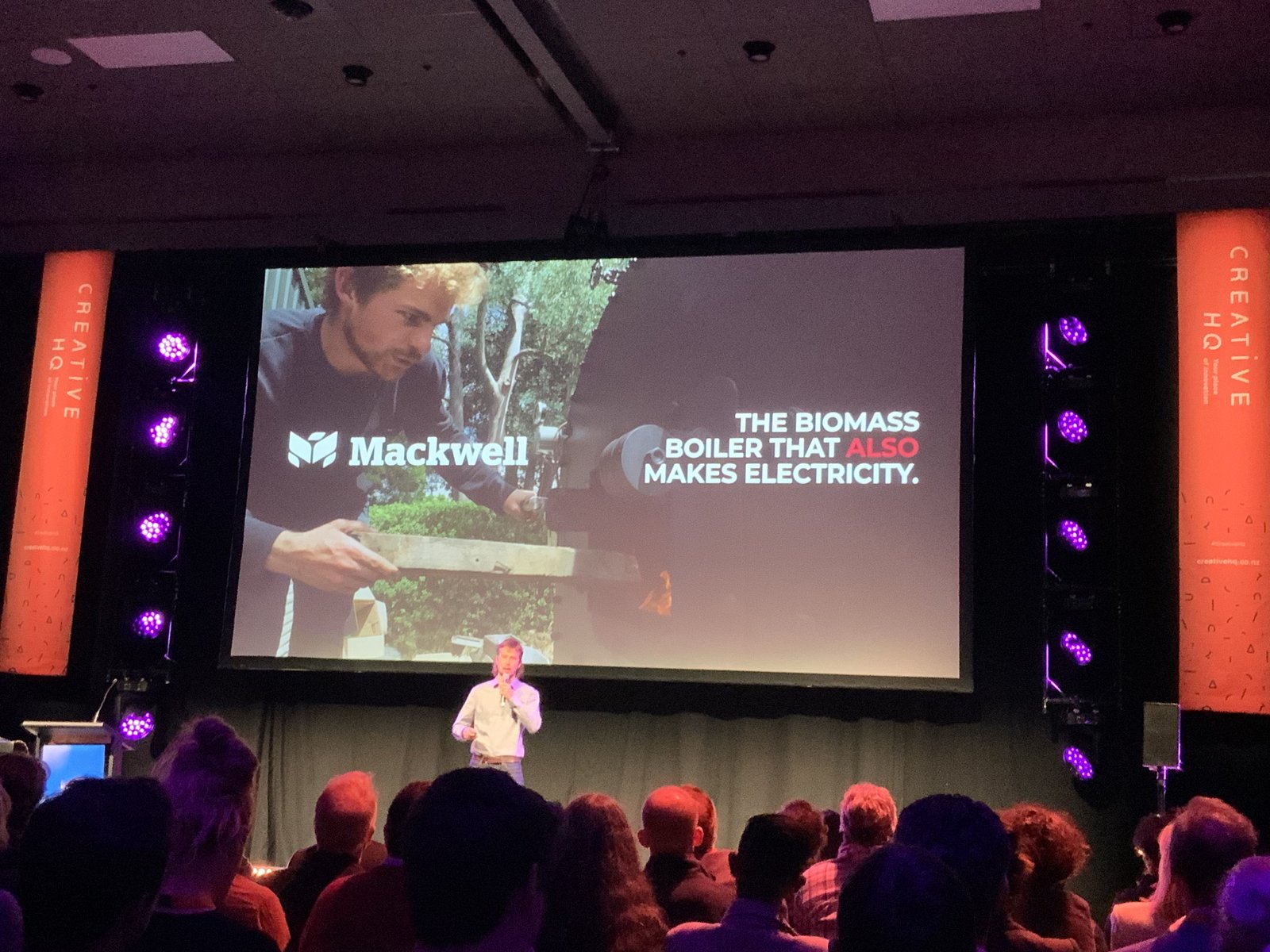
The pipeline these investors assess: Mackwell's "biomass boiler that also makes electricity," pitched in the founder showcase.
The sharpest consensus of the session picked up directly from Alice Havill's keynote: in 2026, "climate tech" is arguably the wrong label, and the green premium is dead.
Vaughan called the shift a rebranding, not a revolution — and warned it can cut both ways. "People's eyes glaze over in corporate Australia now when you talk about climate or sustainability," she said. "But if you talk about solving their problems… there's almost always a climate solution that can help." Frayman agreed the "climate" label was necessary to catalyse early impact capital, but risked "doing us a disservice… because it almost implies or excuses being unprofitable." The real filter, in his telling, is a company solving a real-world problem in a way that has a cost benefit today.
Lindsay put it most bluntly, asking founders in the room to raise their hands if a climate VC had ever funded them without caring about the economics. None did. "You haven't been able to get money from climate-tech VCs if your techno-economics didn't stand up," he said. His advice was to think like the software VCs who returned their funds many times over: back companies that move a market — make a high-temperature, coal-heavy process modular and distributed; shift how an industry operates. And then, memorably: "Just bloody Trojan-horse it. Just get in… and three years in, if you're really game, go: 'sucker — we were a climate-tech company all along.'"
Nixon summarised the mood as "a real sharpening of the pencil": Motion Capital, he said, would be unwilling to invest in a company that makes things more expensive for the customer than the incumbent option.
On subsidies and regulation: nice, not necessary
Asked how they treat regulatory tailwinds and green premiums, the panel was disciplined. Chng said Emerald doesn't underwrite regulatory impact in its base case at all — regulation is "a sweetener or a catalyst" that speeds adoption, not the thesis. He illustrated it with India's PET-bottle recycling rules, which professionalised an already-profitable informal economy. Lindsay agreed the incentives (Australia's VEECs, ARENA grants, or Europe's first-of-a-kind project support) can be crucial for bankability on a company's first plant — but the very next question has to be: "What's your alternative strategy for bankability if we pull the rug?" Vaughan said a 10-year closed-end fund can't count on policy timelines, with energy the one sector where they'll take a bit more regulatory risk, on the hypothesis that strained grids simply have to move.
What a Series A climate company actually looks like
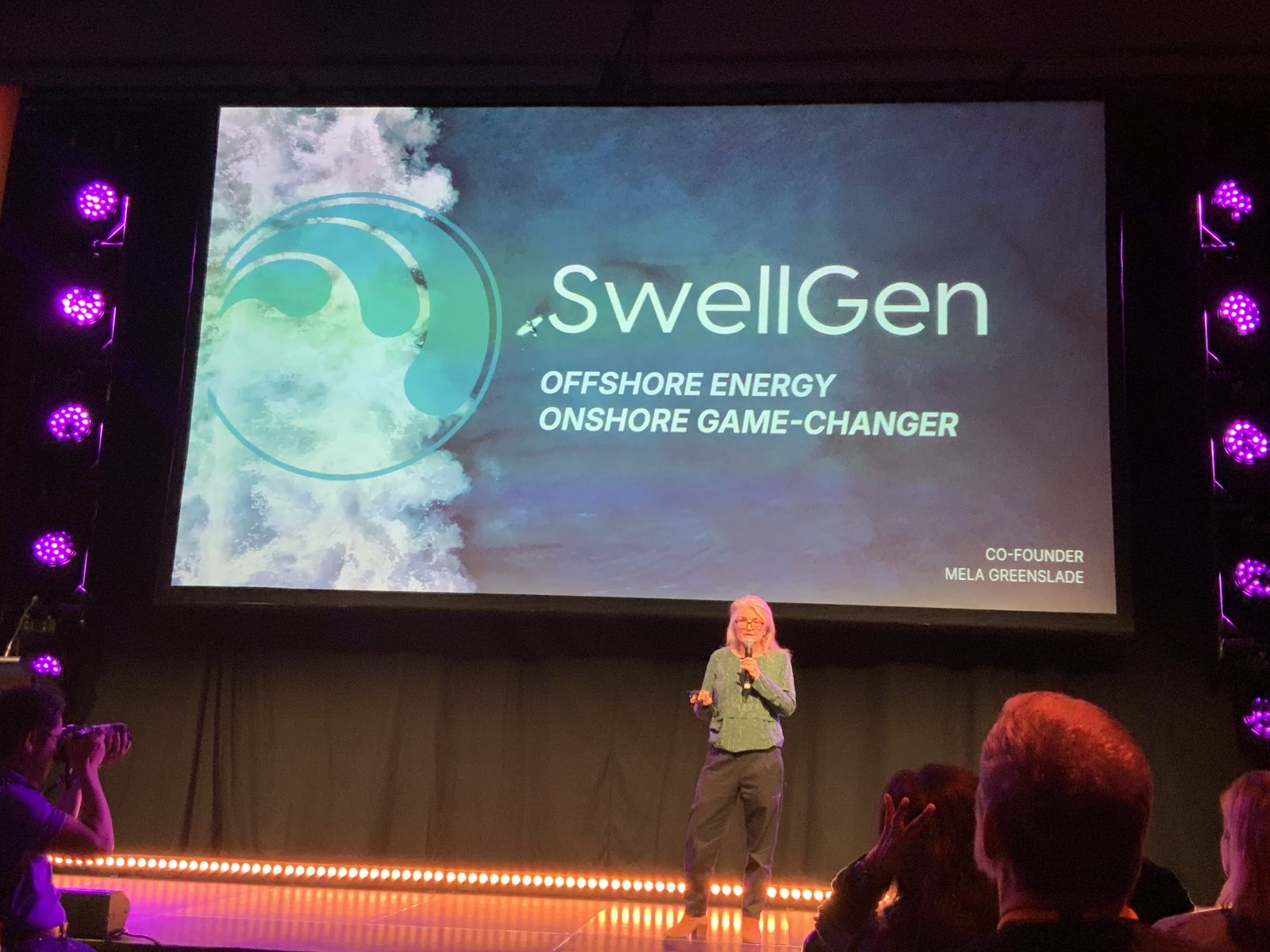
The panel bracketed the Aurora Climate Lab founder showcases — the companies these investors were sizing up, here SwellGen's offshore-energy pitch.
The most practical stretch of the hour answered the question every founder needs answered, because it determines who can raise the larger follow-on rounds. The panel converged on a clear picture:
- Commercial pull is everything. Vaughan said US companies are often better at talking the talk, but the ones that stand out have "really deep insights into where the commercial pull is." She doesn't expect the same slick traction from Australian or Kiwi teams — "it is much harder here" — but evidence of genuine demand is what gets an investor excited.
- For deep tech, revenue isn't required — but proof is. Vaughan and Frayman agreed: a deep-tech company doesn't need revenue at Series A, but it needs a clear IP moat, honest understanding of the technical risk, and evidence of product-market fit — ideally a paid pilot with a serious customer. "If something is paid and a large or mid-cap customer is willing to put money down, that counts for a lot," said Frayman. Software players, by contrast, are expected to show revenue.
- Team depth matters more than we admit. Frayman noted that US teams tend to be deeper than Australian or New Zealand ones, and that planning the team build-out around the Series A is important — many climate companies are technical-first, which is necessary but not sufficient.
- Syndicate quality is part of the deal. Chng flagged something founders often overlook: who else is in the round. Emerald reserves as much for the Series B as it puts into the Series A, a discipline learned from watching good companies with good technology fail during the financial crisis simply because the follow-on market dried up.
The panel ran out of time mid-argument — Chng defending Emerald's "pay-to-play" reserve as the thing that carries a company from Series A to B, Nixon trying to keep it moving. But the through-line back to Alice Havill's morning keynote was unmistakable: sell on economics, prove it with a paying customer, protect the moat, and line up the follow-on before you need it. The pencil, as Nixon put it, has sharpened — and the questions the next cheque will ask are no longer about virtue.
For founders
Field notes: what a founder should take away
- Read the investor's mandate before you pitch. Their backers (corporate LPs, a green bank, a mining group) dictate geography and what they can actually do for you.
- The green premium is dead. Your techno-economics must stand on their own — cheaper, better, faster. "You haven't been able to get money if your techno-economics didn't stand up."
- Don't bank on subsidies or regulation. Treat them as a "sweetener" for first-project bankability, and have a clear answer for "what happens if we pull the rug?"
- Series A readiness (deep tech): a clear IP moat, honest tech-risk understanding, product–market-fit evidence, and ideally a paid pilot with a serious customer. Revenue isn't required for deep tech — but it is for software.
- Commercial pull beats a polished pitch. Show deep insight into real demand; "that's where we get really excited."
- Build team depth around the Series A, and line up (and reserve for) your Series B syndicate before you need it — the follow-on market can dry up.
- Consider Singapore as a one-step gateway to European and US capital; watch Australia's tax and structure shifts (ESVCLP, CGT).
Series · Aurora Climate Tech Summit 2026
- 1. Under One Roof: The Aurora Climate Tech Summit 2026
- 2. "Bring the world to New Zealand": Alice Havill's challenge to Aotearoa's climate-tech founders
- 3. From ambition to adoption: what five parties actually said about climate tech
- 4. The $30 billion circle: inside the bioeconomy breakout
- 5. Scaling from the edge: how Kiwi climate companies actually get into Europe
- 6. What global investors actually look for: inside the international investor panel — you are here
← Previous: Scaling from the edge: how Kiwi climate companies actually get into Europe