There is a particular kind of clarity that comes from someone who has left, gone and done the hard thing somewhere else, and come back to tell you what they learned. That was the tone of the keynote that opened the Aurora Climate Tech Summit at Shed 6.
It was delivered by Alice Havill — a New Zealand-born chemical engineer now based in Colorado, and a Founding Partner of Fractal Climate. Her own path is the argument: she led scale-up work at LanzaTech, the company that ferments waste gases into fuels and chemicals; she was Chief Operating Officer at carbon-fibre recycler Vartega; she has sat on the investment side of the table; and she now teaches climate entrepreneurship, including in the Aurora programme itself. Her keynote — billed as "Climate Tech at scale: global trends, local advantage" — drew on client work across Europe, the US and East Asia. It was generous. It was also not comfortable.
"It's not a science problem anymore"
Havill's first move was to reframe what climate tech even is in 2026. The first wave — call it Clean Tech 1.0, roughly 2000 to 2015 — was a response to the gradual decline in climate stability: biofuels, solar, wind, recycling, batteries. Worthy, but narrow, and forever asking customers to pay a premium for virtue.
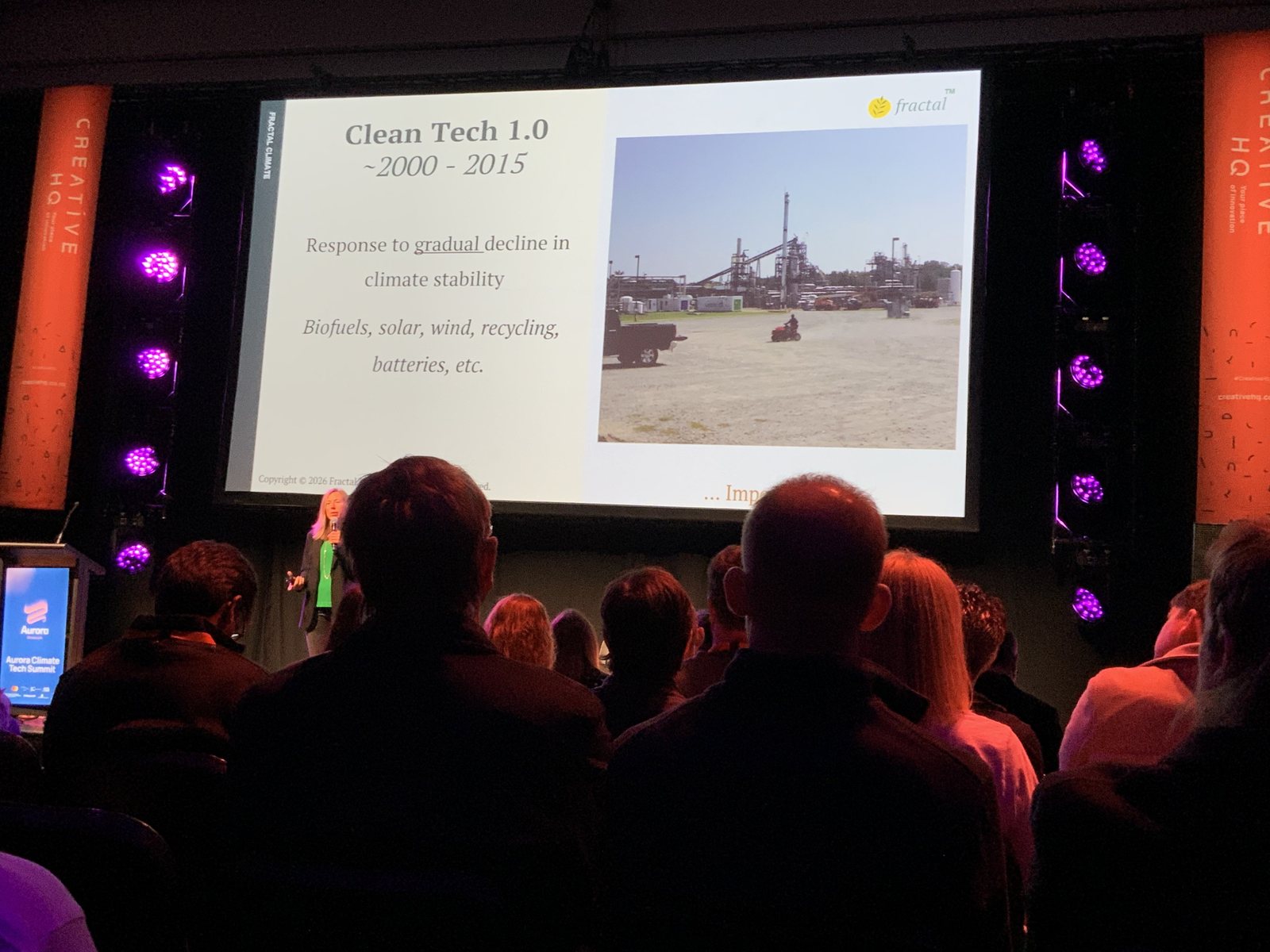
Havill's keynote set "Clean Tech 1.0" — the 2000–2015 wave of biofuels, solar, wind and batteries — against a very different opportunity today.
What she described instead was a second wave defined by industrial advancement, smarter resource management and, crucially, business opportunities that don't need the word "climate" to win. The best climate companies today, she argued, sell on performance and economics first. The decarbonisation is real — but it rides along with a product that is simply better and cheaper, not one that asks the buyer to care.
That distinction matters enormously for how a founder pitches, and to whom.
The one thing we get wrong
New Zealand, in Havill's telling, is world-class at the front of the pipe. "We're built on a culture of collective intelligence and applying the solution together," she said. The gap opens further along. "Where we don't match up is in our market opportunities," she said. "We get so focused on being here, we go after New Zealand markets, maybe an Australian market."
The problem with that instinct is financial as much as it is strategic. A small home market can't generate the profitability — the cash flow — that justifies building the pilot in the first place. Her prescription was blunt: go and find the global problem that is large enough, and urgent enough, that someone will pay for the answer today, and align your solution to that.
The line that the room kept repeating afterwards was the inversion at the heart of the talk:
"Let's bring the world to New Zealand, rather than send the New Zealand companies to the world."
Why you should still pilot here
None of this was an argument for leaving. Quite the opposite. Havill made an unusually specific, operational case for New Zealand as the best place on earth to build the thing — even when the customer is on the other side of the planet.
We pilot faster and cheaper here, she argued, and there is a genuine cash advantage to doing so. She described the New Zealand model as world-class minds — an operator and a PhD in the same room — "respectfully talking to each other and solving the problem together." That, she said, "is music to an investor's ears."
Her worked example was Aspiring Materials in Christchurch, whose rock-digestion process yields, among other things, a high-value magnesium product for agriculture. New Zealand is nowhere near their end market — and yet they pilot here, because the team can prove economic and market viability faster and more cheaply than they could elsewhere. She was emphatic about how good that work is: better, she said, than a lot of what she has watched attempted in Palo Alto or Boston, "and getting the results."
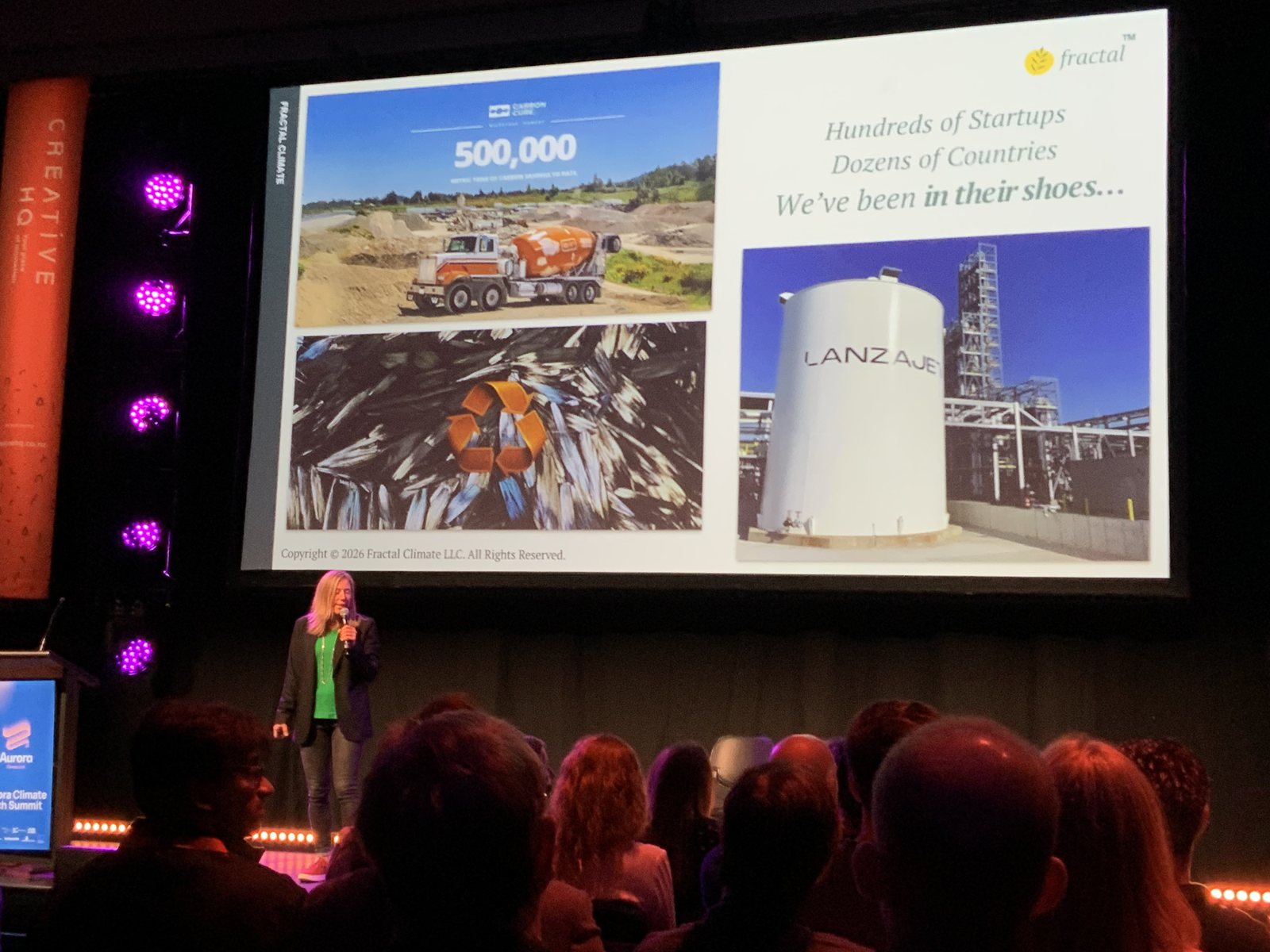
Havill drew on scale-up work across hundreds of startups and dozens of countries — "we've been in their shoes."
Piloting is a "Frankenstein effort"
The most useful part of the keynote, for anyone actually building, was her description of what piloting really is — because it is not a tidy graduation from lab to market.
"You've got the scientific idea, the market's told you roughly this is what they need… and then you build your first prototype," she said. "You turn it on. This thing doesn't work. And then you kick it, and you play with it. You pull this out and you push that in." That messy loop is where the value hides: "You end up discovering intellectual property you didn't know was the intellectual property that protects you in the market. And you discover ways to bring the cost down."
That gap between price and cost — she called it the delta — is what turns a science project into a business. And it is discovered on the pilot floor, by kicking the machine until it behaves.
The squiggly line, not the hockey stick
Havill was equally honest about the shape of the journey. It is not the smooth exponential curve of a pitch deck. "It's this squiggly line in the middle," she said — volatile, uncertain, full of pivots. Founders survive it, in her account, because they have "a deep wiring commitment to the long-term cause," not because they were promised a straight line.
And where a company scales offshore, she argued, the core can and should stay in Aotearoa. "You're not exporting products," she said, "you're exporting the solutions, the designs, the technology, the technology control systems, the IP." Shipping electrons and know-how, she pointed out, is far more efficient than shipping tanks, pipes and valves — and it keeps the high-value research, the tax base and the next generation of hard problems here at home.
Her roll-call of Kiwi companies already running this play was specific: Aspiring Materials into Europe and the UAE; Liquium into Japan and South Korea with Australia as a base; Terraform into defence applications in the southern US; Rift into the Netherlands and Germany.
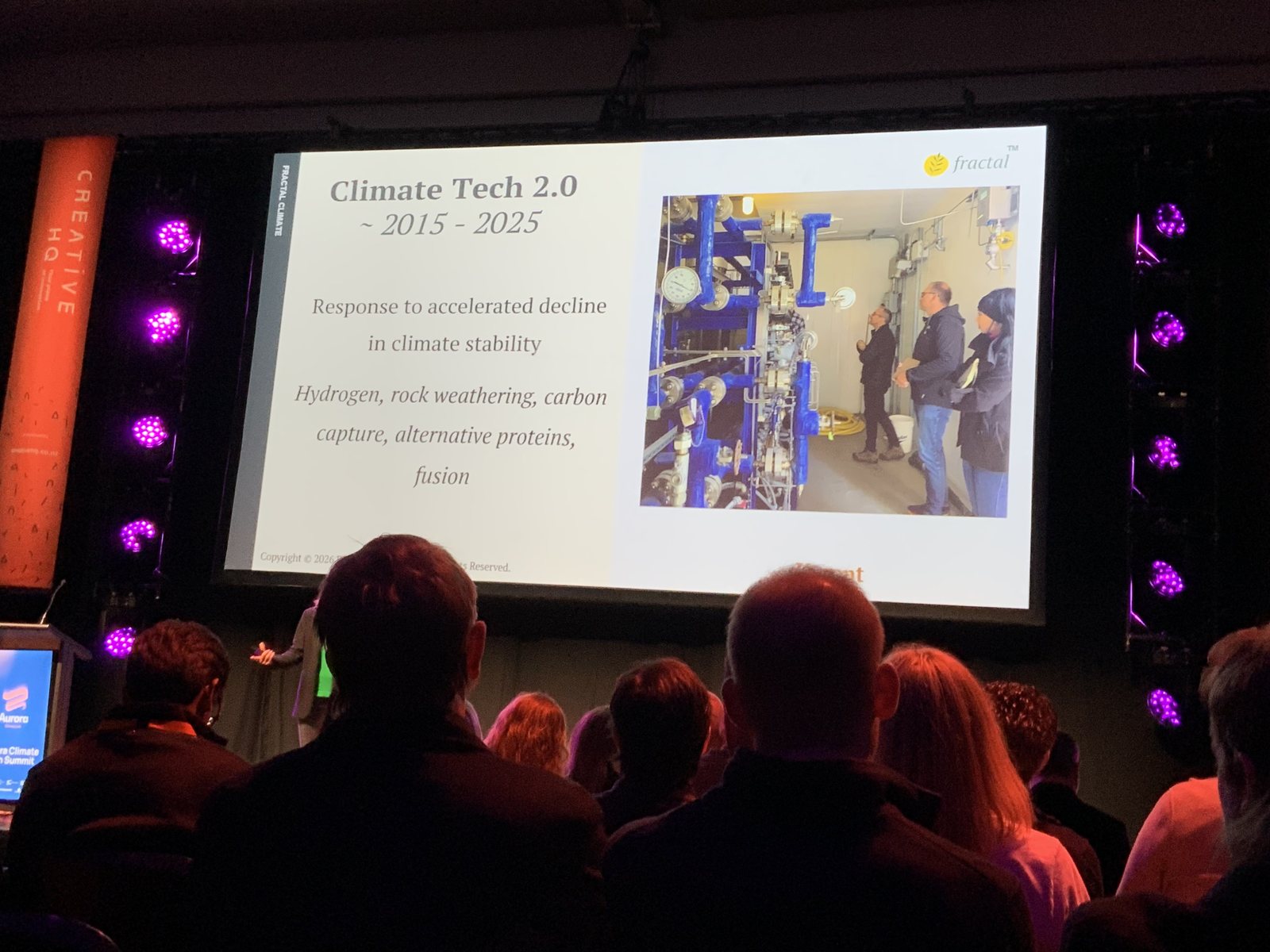
The sectors defining her "Climate Tech 2.0" era (~2015–2025) — hydrogen, fuel switching, carbon capture, alternative proteins and fusion — the technologies she argues New Zealand can build here and export.
Being at the bottom of the world, she argued, is a feature. "No one knows what's going on down here," she said. "And suddenly a New Zealand company pops up with a solution that everyone went, 'Where did it come from?' You have an IP advantage to hide it here. You have a cost of capital that's cheaper, and you have partners that can support you."
The asset we're not using
If there was a single under-used lever in her diagnosis, it was people. "The asset is our network," she said. "Five million people here, but so many around the world," embedded in corporations and governments and communities that hold the knowledge a founder can't find online. "You can't research this on the internet… you have to go talk to people. And no one is better at connecting people around the world than New Zealanders — but it only works if we help each other."
So she closed with a task for the room, not a flourish. Connect with at least one team before the day was out. Offer them one contact, one piece of knowledge, one door: either a piloting partner here in New Zealand, or a line into the overseas market where their problem is genuinely big. "This journey is very hard," she said. "It is very rewarding, but it is very, very hard. And these teams know it's worth it — but they need your help."
She was candid that survival isn't really about the money. "You can listen to the Aurora teams who dream them for us," she said. "They know this is hard. They're not naive, but they do it because they know why they're doing it. They have a deep wiring commitment to the long-term cause." And on how New Zealand companies too often sell, she was blunt: "We're over-pushing solutions to the market — it has to be pulled in." Find the market that is being pulled toward you, in other words, and the rest of the journey has a reason to happen.
For founders
Field notes: what a founder should take away
- Pilot in New Zealand — it's a cash advantage. You prove economics faster and cheaper here; the "delta" between price and cost gets discovered on the pilot floor, not in a spreadsheet.
- Treat piloting as a "Frankenstein effort." Expect to turn it on, watch it fail, and kick it until it works — that mess is where you find the IP that actually protects you.
- Sell value premiums, not climate premiums. Win on performance and cost; let the decarbonisation ride along. "You should care about the environment as much as I do, and pay more for it" is not a strategy.
- Chase a global problem, not an NZ-sized one. Find the market that is being pulled toward your solution — "it has to be pulled in."
- Export the IP, designs and control systems — not tanks, pipes and valves. Keep the core (and the tax base) onshore while the deployment scales offshore.
- Work the network. Before you leave a room like this, get one concrete thing — a piloting partner, a market contact, a warm intro. "You can't research this on the internet."
- Expect a squiggly line, not a hockey stick — and make sure your "why" is strong enough to survive it.
Series · Aurora Climate Tech Summit 2026
- 1. Under One Roof: The Aurora Climate Tech Summit 2026
- 2. "Bring the world to New Zealand": Alice Havill's challenge to Aotearoa's climate-tech founders — you are here
- 3. From ambition to adoption: what five parties actually said about climate tech
- 4. The $30 billion circle: inside the bioeconomy breakout
- 5. Scaling from the edge: how Kiwi climate companies actually get into Europe
- 6. What global investors actually look for: inside the international investor panel
← Previous: Under One Roof: The Aurora Climate Tech Summit 2026 Next: From ambition to adoption: what five parties actually said about climate tech →