The bioeconomy breakout — "Future Value from Nature" — was the session we'd circled on the programme, and it did not disappoint. The framing number is well known by now: Scion and PwC have put the domestic bioeconomy opportunity at around NZ$30 billion, with bioenergy alone already worth roughly $6 billion a year. What made the hour worthwhile was that nobody in the room treated that figure as a victory lap. They treated it as an indictment — proof of how much value the country is currently letting rot, burn or ship offshore as raw logs.
Wayne Mulligan: "monetise the whole tree"
The clearest articulation of the prize came from Wayne Mulligan, who leads NZ Bio Forestry and Fomana Capital. His opening was a deliberate reframing. "It's not a scientific issue anymore," he said. "It's an engineering, it's an economic, and it's an environmental play." The science, in other words, is largely solved. The failure is one of deployment and capital.
His numbers made the waste visceral. Of the roughly 32 to 35 million cubic metres of wood the country produces, about 22 million leaves as raw logs — value added somewhere else, by someone else. The opportunity he described is to keep that value here: "How do we take a hundred-dollar log and turn that into three to five to ten thousand US for the same tonnage? Now that's productivity." Every part of the tree, in this vision, has a destination — the best timber into engineered wood products and long-term stored carbon, the residual fibre into a bio-refinery producing biochemicals, bioplastics, bioenergy and future renewable fuels. "Monetise the whole tree. No waste."
He was insistent that the value isn't only in the molecules. As you make the products — "whether they're wood products, chemical products, energy products, material products" — "you're actually starting to capture the metrics and building new knowledge and data that can be monetised," he said, "because it's all decarbonisation, it's carbon capture, it's low emissions — and there's a fundamental driver in the investors that we're talking to who want that as well." The harder part, he added, isn't the chemistry: "It's actually about integrating the systems… capturing the data and metrics along the way."
He gave the programme behind it a name with two meanings. WERO stands for Wood Energy Refining Optimisation — but wero, in te reo Māori, means the challenge. "It also means the challenge to look after our community," he said, "because our communities deserve better." The organising idea he kept returning to was captured on the session's slide: resilience, productivity and scale — repurpose the assets and resources we already have, lift the value we extract from each tonne, and build to a size that matters globally.
In the press materials afterwards, he put the deployment gap even more plainly:
"Every forest in this country is a standing store of carbon and hydrogen that can replace fossil-based chemicals and fuels — and a large share of that biomass is currently left to rot or burn. A $30 billion opportunity doesn't scale on invention alone; it scales on investment, offtake and the infrastructure to bridge pilot to industrial production." — Wayne Mulligan, NZ Bio Forestry
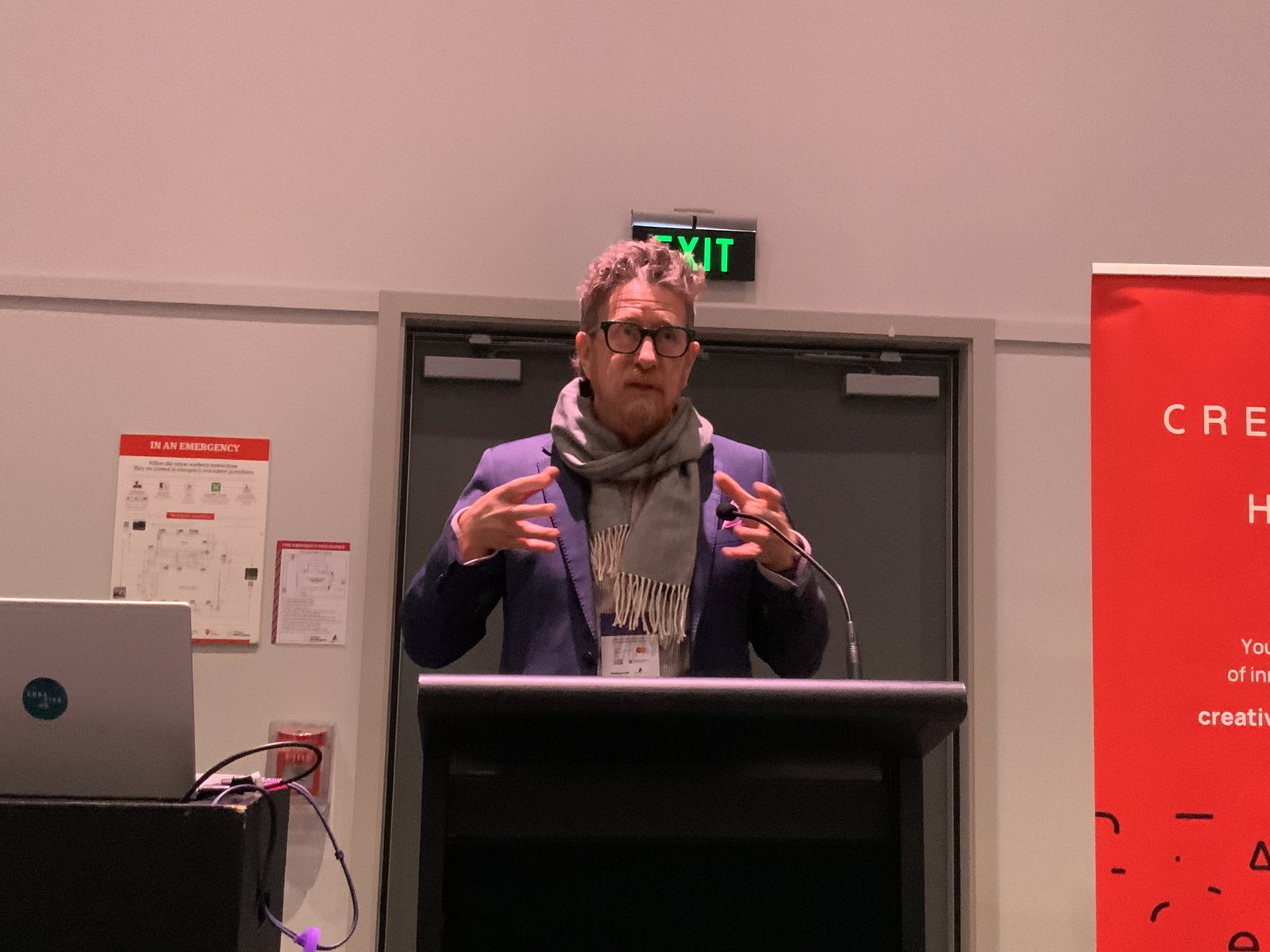
Four lightning speakers set up the discussion in the "Future Value from Nature" breakout.
Michael Lakeman: the circle, not the product
If Mulligan supplied the ambition, Michael Lakeman of Rock Stack supplied the mental model that gave the session its title. The bioeconomy, he argued, is not a single hero product; it is a system in which one region's residues become another product's feedstock.
"The bioeconomy isn't one product — it's a circle," he said. "The same ag and aqua residues, wood fibre, seaweed and biomass crops we treat as low-value can feed liquid fuels, firming energy, fertiliser, materials and animal feed all at once. Do it well and the by-products are the things every region wants: jobs, cleaner water, restored ecosystems and less waste to landfill."
He also made a point aimed squarely at founders about how to keep policy on side: the public value a bioeconomy company creates is part of its product, and it has to be sold as deliberately as the product itself. Governments change — but so do customers — so companies need to build durable coalitions of advocacy rather than depending on any one administration's enthusiasm.
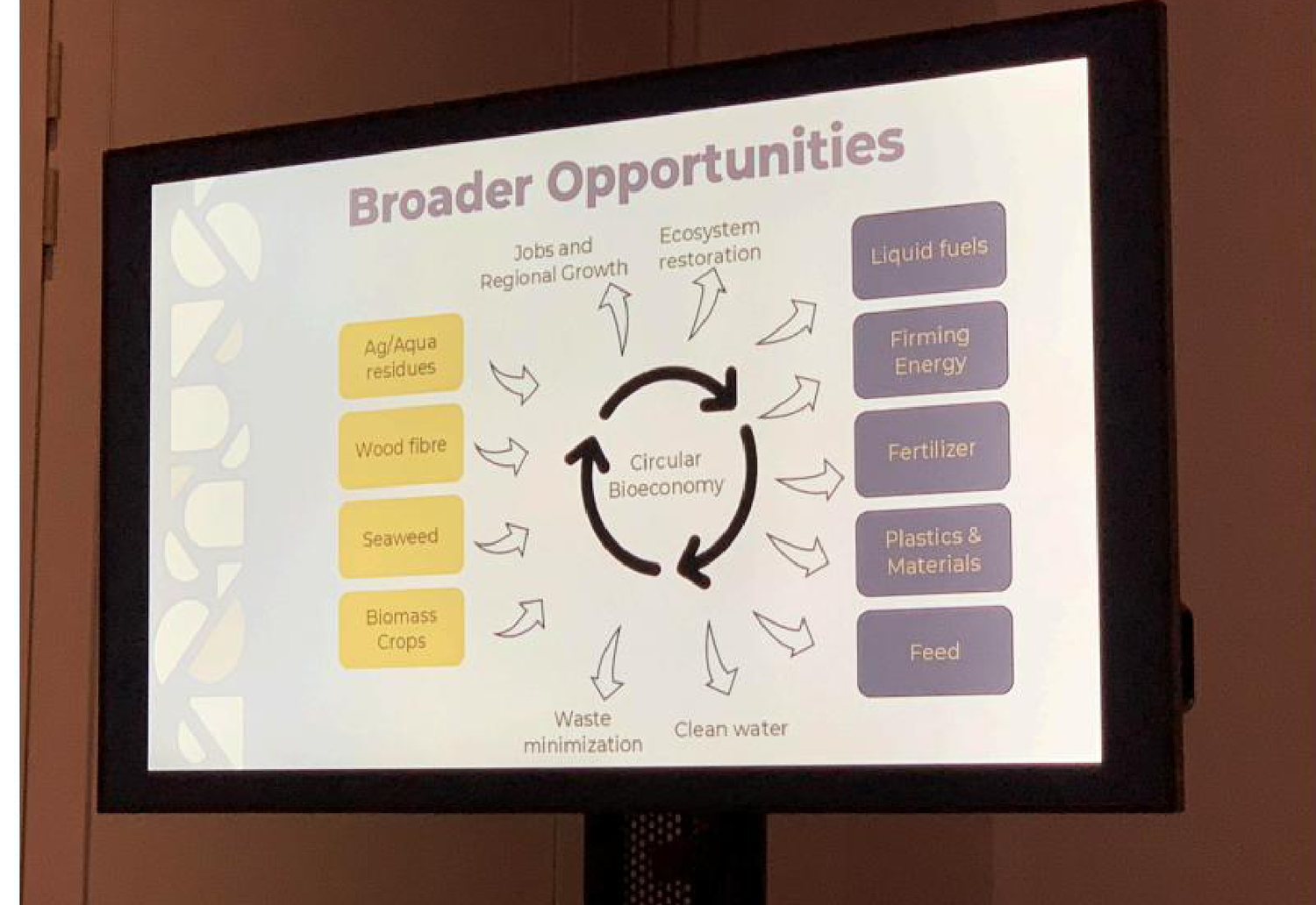
The circular framing: ag and aqua residues, wood fibre, seaweed and biomass crops feeding fuels, energy, fertiliser, materials and feed — with jobs, clean water and restored ecosystems as by-products.
Three provocations, designed to sting
Rather than end on consensus, the facilitators put three deliberately sharp provocations to the room. They're worth quoting because they name the exact places the country gets stuck:
-
Invest at scale, or stay a hobby. New Zealand sits on world-class biological resources it underuses. The real barrier to a bioeconomy isn't technology — it's a failure to invest at the scale needed to turn advantage into a global industry. What single thing — a policy, a commercial arrangement, a piece of infrastructure — would move fastest?
-
The clean-green trade-off. Our biosecurity and GE regulations protect the clean-green brand, but arguably make us uncompetitive. As one audience member sharpened it on the screen: in a world of shifting climate baselines, are those rules "fit for purpose, or a Maginot Line"? Can we really keep both forever?
-
Good at inventing, bad at deploying. New Zealand is good at funding bioeconomy solutions and bad at deploying them at scale — and the bottleneck is not more R&D funding. It's everything that comes after the science.
The room pushed back
The best sign of a live session is that the audience argues, and this one did — in real time, on Slido.
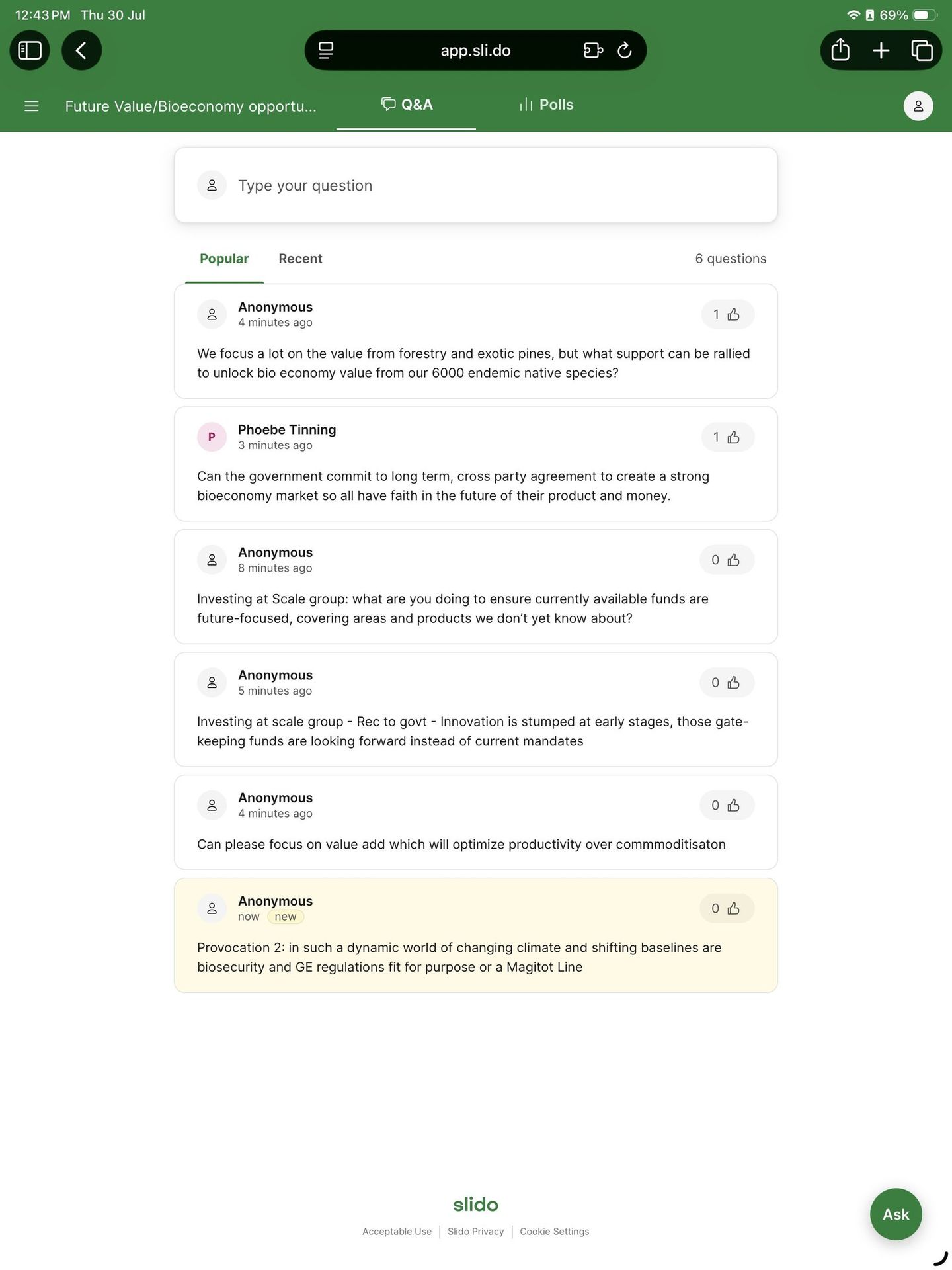
Real-time audience questions during the breakout, including the native-species challenge that would echo into the afternoon's political forum.
The question that drew the most support — and that resurfaced, pointedly, in the afternoon's political forum — came from an anonymous delegate: "We focus a lot on the value from forestry and exotic pines, but what support can be rallied to unlock bioeconomy value from our 6,000 endemic native species?" It's the right challenge to a forestry-heavy vision, and nobody had a tidy answer.
Phoebe Tinning asked whether government could commit to a long-term, cross-party agreement to underpin a bioeconomy market, "so all have faith in the future of their product and money" — the investability question that every founder in the room felt in their bones. Others pressed the funders directly: that innovation is being "stumped at early stages" by gatekeepers "looking forward instead of current mandates," and a plea to "focus on value-add which will optimise productivity over commoditisation" — which is, of course, Mulligan's hundred-dollar-log point coming back around.
If the hour had a closing note, it came from the facilitator wrapping up the lightning talks: what the sector can learn, she suggested, from "nature's design principle of circularity and making no waste" — building our economic models around that idea rather than against it. It was the through-line from Mulligan's whole-tree economics to Lakeman's circle. The value New Zealand keeps leaving on the table, the room seemed to agree, isn't a single product — it's the system that connects the residues to the markets, and the investment to bridge the two.
For founders
Field notes: what a founder should take away
- Reframe it as engineering, economics and environment — not science. The science is largely solved; the gap is deployment and capital.
- "Monetise the whole tree." Highest-value timber → engineered wood + stored carbon; residual fibre → biorefinery (biochemicals, bioplastics, bioenergy, fuels). Aim to turn a $100 log into $3,000–$10,000 of product for the same tonnage.
- Capture the data as you produce. The decarbonisation, carbon-capture and low-emissions metrics are themselves monetisable — "and there's a fundamental driver in the investors… who want that as well."
- Think in circles, not products. One region's residue is another's feedstock; the by-products (jobs, clean water, restored ecosystems, less to landfill) are the regional win.
- Know the three barriers named in the room: invest at scale; resolve the biosecurity/GE-vs-clean-green tension; and fix "good at inventing, bad at deploying."
- Sell the public value deliberately and build cross-party advocacy — governments change, but so do customers.
Series · Aurora Climate Tech Summit 2026
- 1. Under One Roof: The Aurora Climate Tech Summit 2026
- 2. "Bring the world to New Zealand": Alice Havill's challenge to Aotearoa's climate-tech founders
- 3. From ambition to adoption: what five parties actually said about climate tech
- 4. The $30 billion circle: inside the bioeconomy breakout — you are here
- 5. Scaling from the edge: how Kiwi climate companies actually get into Europe
- 6. What global investors actually look for: inside the international investor panel
← Previous: From ambition to adoption: what five parties actually said about climate tech Next: Scaling from the edge: how Kiwi climate companies actually get into Europe →