Insights from the Ministry for the Environment Webinar on Emerging Regulations with Taumata Arowai
New Zealand's wastewater sector is navigating significant regulatory change. A recent Ministry for the Environment (MFE) webinar brought together key voices to unpack Taumata Arowai's new performance standards for wastewater treatment plants and what they mean for councils, iwi, and infrastructure providers across the country.
The session featured presentations from the Water Services Authority - Taumata Arowai via the Ministry for the Environment
Sara McFall, Head of Systems, Strategy & Performance
Janelle Eagleton, Senior Policy Advisor
Marcus Bishop, Senior Policy Advisor
Simone Palmer, Principal Policy Advisor
Each offered distinct perspectives on implementation, compliance timelines, and the gaps that remain.
The Grace Period: A Line in the Sand
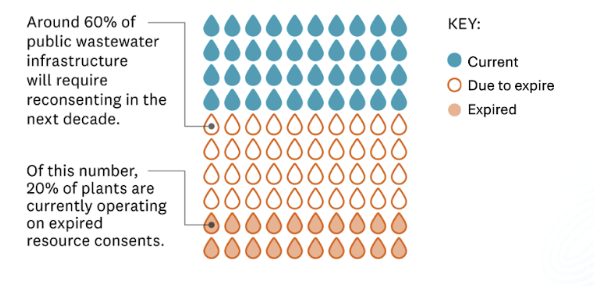
For treatment plants currently operating on expired consents, the new framework establishes August 2028 as the deadline to meet performance standards. This grace period acknowledges the reality that many facilities have been operating in regulatory limbo. In one remarkable case, a wastewater treatment plant has been running on an expired consent for 24 years.
The 2028 deadline provides breathing room, but it also creates urgency. Councils and operators now have a defined window to upgrade infrastructure, secure funding, and align with the new standards.
What's Missing: Heavy Metals and PFAS
Two notable gaps emerged from the discussion.
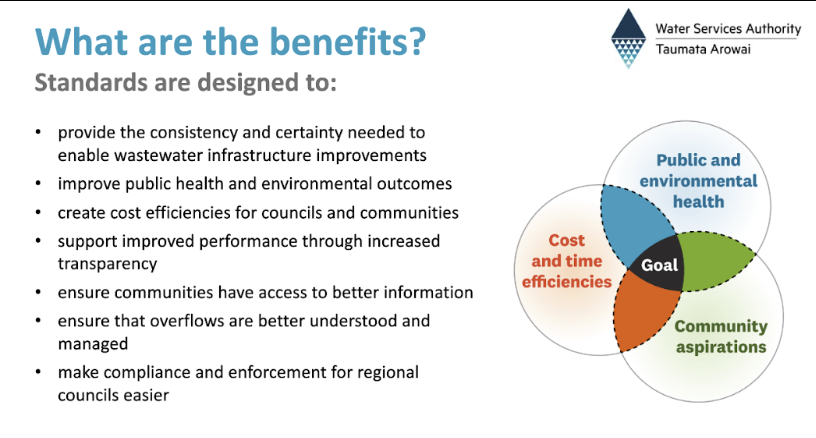
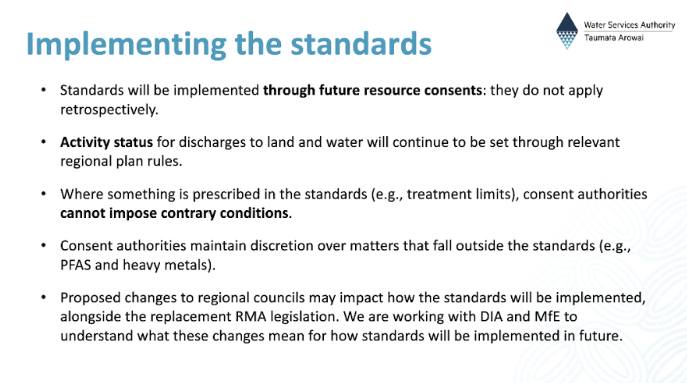
First, while regulations address heavy metals in biosolids (the solid residue from treatment), there is currently no standard for heavy metals in liquid effluent. The assumption that heavy metals will always precipitate into sludge may not hold true across all treatment scenarios. Taumata Arowai acknowledged this gap during the session, indicating they will pick it up later.
Second, and perhaps more significantly, there is no mention of PFAS (per- and polyfluoroalkyl substances) limits in either sludge or effluent. These so-called forever chemicals have become a major concern globally, yet New Zealand's new standards do not yet address them. Again, this is flagged for future regulatory development.
Discharge to Air: Another Gap
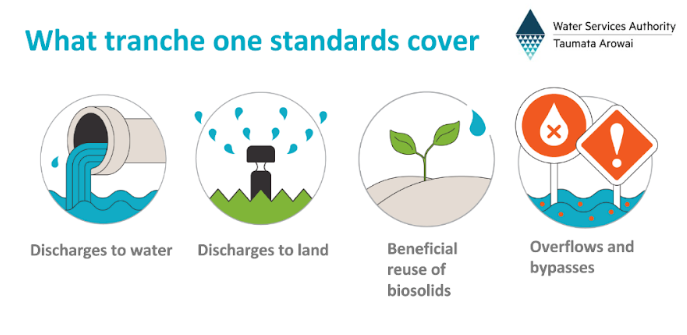
The current standards also lack provisions for atmospheric discharges, specifically methane and nitrous oxide, both potent greenhouse gases generated during wastewater treatment. As climate accountability frameworks mature, this gap will likely close, but for now it remains outside the compliance scope.
Iwi Partnership: Central to the Framework
Perhaps the most forward-looking element of the new approach is the explicit role for iwi and hapu in consent conditions for discharges to land. Under the framework, Taumata Arowai and regional councils will work directly with iwi and hapu on site-specific consent conditions. Iwi will develop site classifications for discharge locations. Monitoring, reporting, and site-specific management plans will be iwi-led.
This structure reinforces what many in the sector already recognise: meaningful progress on wastewater infrastructure requires genuine partnership with tangata whenua. For councils considering land-based discharge solutions, such as those in Marlborough and Palmerston North where iwi have expressed preference for discharge to land over waterway discharge, early and authentic engagement will be essential.
Proven Overseas, New to New Zealand
For councils facing the 2028 deadline, solutions exist that are mature globally but have yet to be deployed at scale in New Zealand. Co-digestion technology, which combines sewage sludge with carbon-rich organic waste to optimise treatment and energy recovery, is standard practice overseas but remains uncommon here.
Co-digestion is standard practice in Europe and the US. It's not experimental - it just hasn't been deployed here yet.
We're not inventing anything new. We're bringing proven capability to New Zealand - the same engineering, the same process, the same team that has delivered this overseas.
Lower Risk Than Processing Biosolids Alone
Counterintuitively, co-digestion is actually lower risk than attempting to process biosolids in isolation. Sewage sludge on its own has a poor carbon-to-nitrogen ratio, which can cause ammonia toxicity and digester instability. By blending sludge with carbon-rich organic waste, the process becomes more stable and predictable.
Co-digestion is actually lower risk than processing biosolids alone. The carbon-rich feedstock stabilises the process and prevents the ammonia inhibition that causes so many standalone sludge digesters to fail.
Looking Ahead
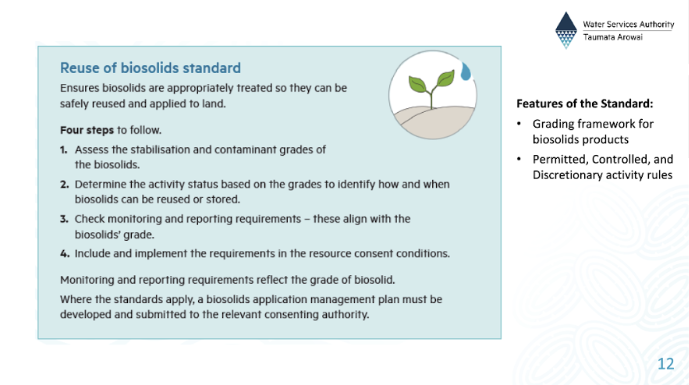
The new performance standards represent a significant step toward improving New Zealand's wastewater outcomes. But as the webinar made clear, the regulatory framework remains a work in progress. Heavy metals in effluent, PFAS, and atmospheric emissions all await future attention.
For infrastructure providers, councils, and iwi partners, the message is clear: the window to act is now. August 2028 will arrive faster than many expect, and the projects that succeed will be those that move decisively while building the relationships needed to navigate an evolving regulatory landscape.
CONTACT US for a solution for your biosolids.
.