Wastewater Desludging: A Hidden Opportunity in the Global Water Crisis
The world's wastewater treatment plants are sitting on an untapped resource—and forward-thinking councils are already moving to capture it.
The United Nations just declared we've entered an era of global water bankruptcy. According to a landmark report from the UN University Institute for Water, Environment and Health (UNU-INWEH), the familiar terms "water stress" and "water crisis" no longer describe today's reality. We've moved beyond crisis into something more permanent: a post-crisis condition where many water systems can no longer bounce back to historical norms.
This isn't just an environmental warning—it's a signal that wastewater infrastructure must evolve. And for municipalities willing to rethink their approach, there's a significant opportunity hiding in their treatment ponds.
The Desludging Imperative
Every wastewater treatment plant accumulates sludge—the semi-solid material left behind after treatment. Traditionally, this material has been viewed purely as a disposal problem: something to be trucked away, landfilled, or incinerated at significant cost.
But that paradigm is shifting.
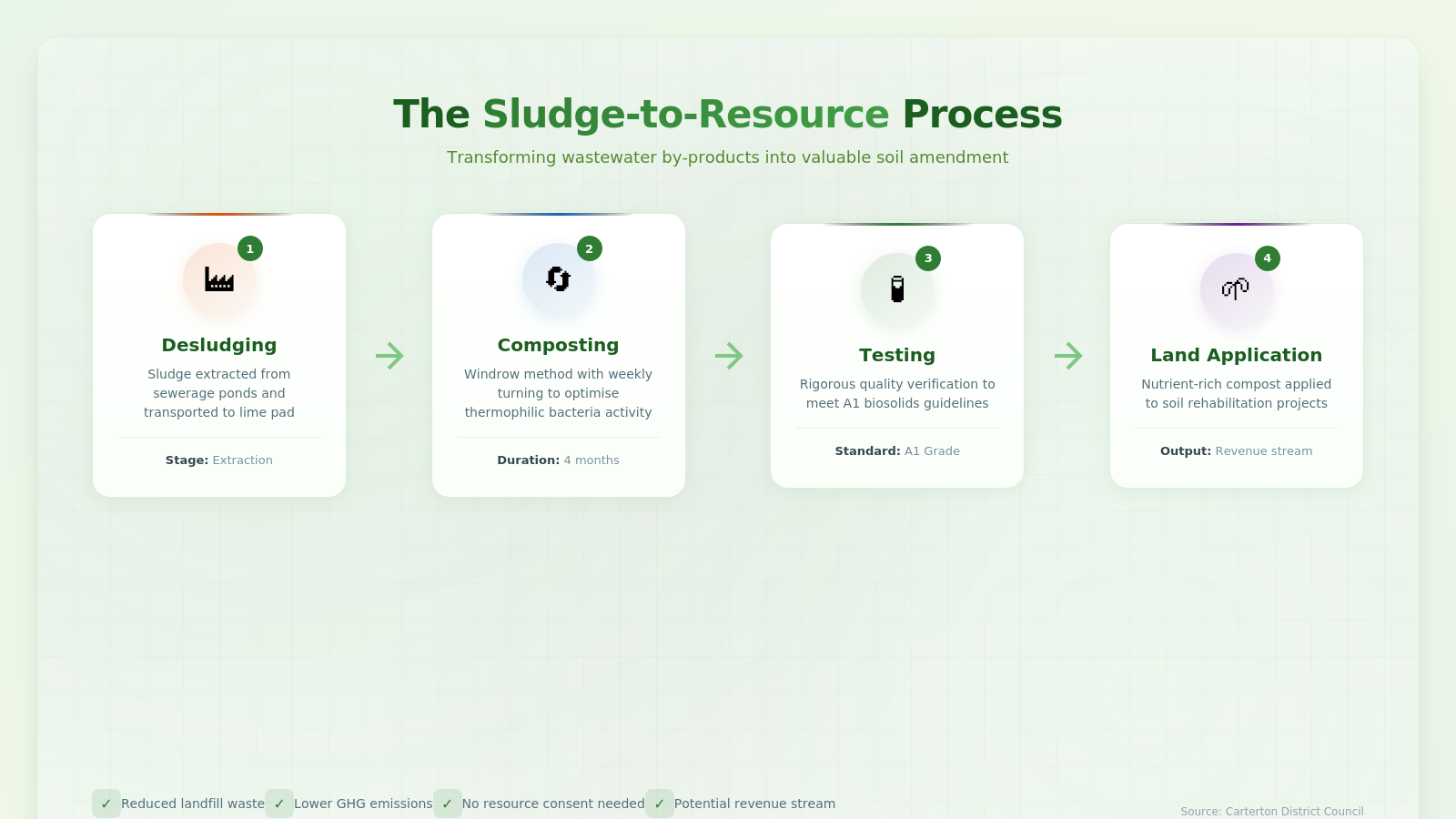
Carterton District Council in New Zealand recently launched a desludging trial that's attracting attention from councils across the country. Their approach transforms sewerage pond sludge into A1-grade biosolids—a nutrient-rich compost suitable for land rehabilitation. It's a model that reduces landfill waste, eliminates resource consent requirements, and potentially creates a new revenue stream.
Key terms driving this shift:
- Biosolids recovery — extracting value from wastewater treatment by-products
- Sludge-to-resource — treating organic waste as feedstock, not disposal
- Wastewater asset optimisation — maximising returns from existing infrastructure
- Circular water economy — closing the loop on water treatment outputs
The Methane Question
Here's what most desludging conversations miss: the methane.
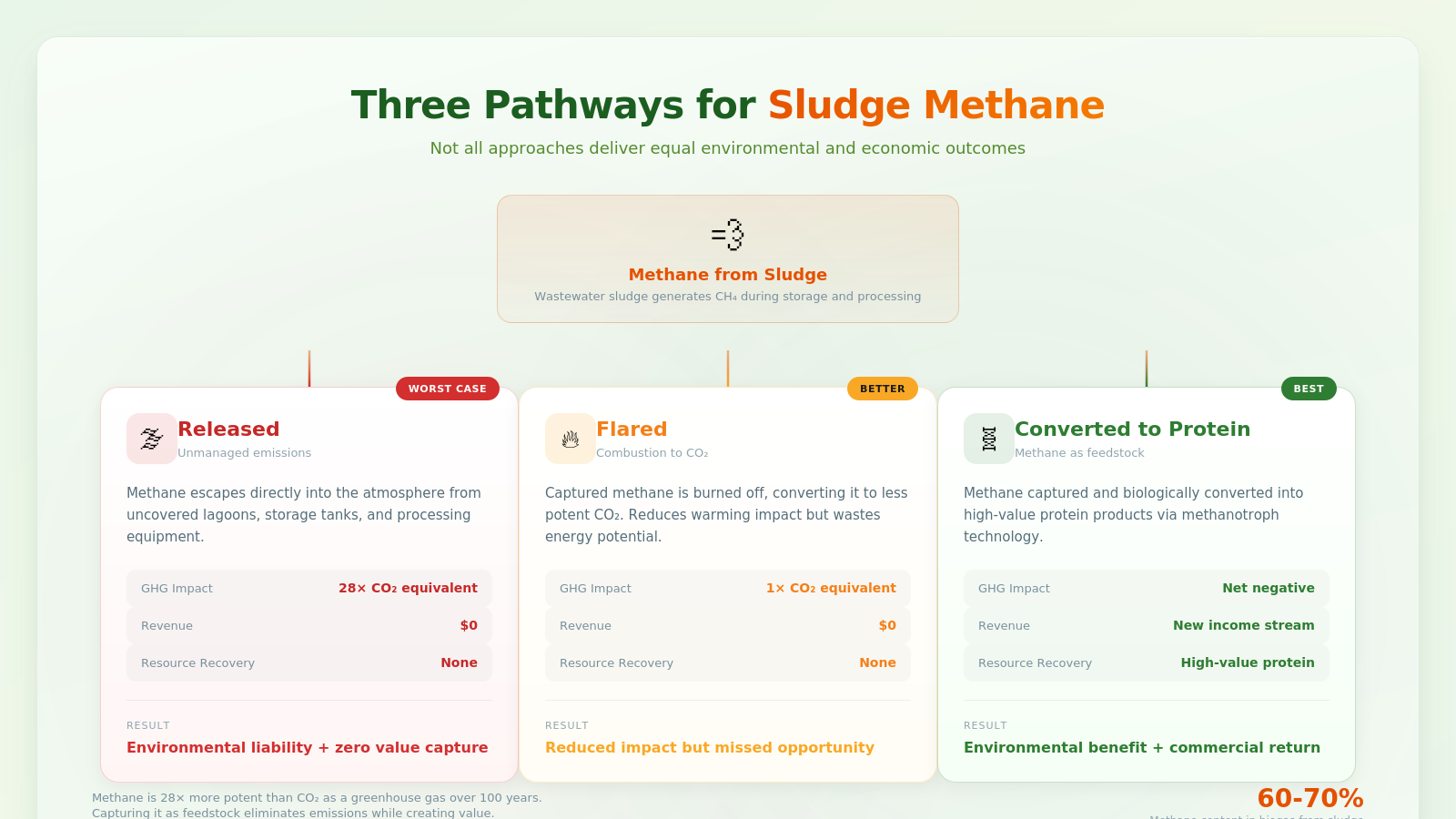
Sludge management is one of the largest sources of methane emissions at wastewater treatment facilities. When organic material decomposes in storage ponds, holding tanks, or during processing, it releases methane—a greenhouse gas 28 times more potent than CO₂ over a 100-year timeframe.
Composting sludge on lime pads, as Carterton is doing, reduces emissions compared to landfilling. That's genuinely positive. The compost returns nutrients to the soil. The process avoids complex mechanical treatment. It's low-cost and effective.
But it leaves something on the table.
From Waste to Feedstock
What if that methane wasn't just captured—but transformed?
We're partnering with Carbon Bridge to do exactly that. Their technology converts methane emissions into high-value protein, creating an additional revenue stream while eliminating a potent greenhouse gas.
The logic is straightforward:
- Soil amendment is good. Returning nutrients to land supports sustainable agriculture and rehabilitation.
- Unmanaged methane is harmful. Released into the atmosphere, it accelerates warming. Flaring converts it to CO₂—better, but still a waste.
- Captured methane is valuable. As a feedstock, it becomes the input for protein production, energy generation, or upgrading to renewable natural gas.
For councils and utilities weighing desludging options, this reframes the decision. It's not a choice between environmental responsibility and economic return—it's both.
Why This Matters Now
The UN's water bankruptcy report makes clear that the current global water agenda—focused largely on efficiency and sanitation—is no longer sufficient. The authors call for a new framework: one that recognises water systems as interconnected, invests in natural capital, and transforms water-intensive sectors.
Wastewater treatment sits at the centre of that transformation. The sector consumes roughly 2% of national electricity in developed countries. Sludge handling alone can account for 30% of a plant's operating costs. And the methane emitted from treatment facilities contributes meaningfully to national emissions inventories.
Every one of those challenges is also an opportunity:
- Energy costs become energy revenue when biogas is captured
- Disposal costs become product sales when sludge becomes compost
- Emissions liabilities become feedstock value when methane is converted to protein
The Path Forward
Councils like Carterton are proving that desludging can be done responsibly and economically. The next step is ensuring we're not leaving value—or environmental impact—unaddressed.
If your organisation is planning or operating a wastewater treatment facility, the questions to ask are:
- What's our current sludge management approach, and what's it costing us?
- Are we capturing biogas? If so, what's happening to it?
- Could methane conversion create a revenue stream while meeting emissions targets?
The answers might reveal that your wastewater treatment plant isn't just a cost centre. It's an asset waiting to be optimised.
For more on methane-to-protein technology and partnership opportunities, visit carbonbridge.io.
Sources:
- UN University Institute for Water, Environment and Health — "Global Water Bankruptcy: Living Beyond Our Hydrological Means in the Post-Crisis Era" (January 2026)
- Carterton District Council — "Wastewater Treatment Plant Desludging"
#Biosolidsrecovery #Sludge-to-resource #Wastewaterassetoptimisation #Circularwatereconomy