By Alimentary Systems Limited | February 2026
In October 2020, four months before Alimentary Systems was registered as a New Zealand company, our founders presented a circular bioenergy approach to wastewater to the Wellington City Council. The events of February 2026 underscore why this work matters — not just for Wellington, but for communities across the country.
On 4 February 2026, Wellington's Moa Point Wastewater Treatment Plant experienced a major failure. The plant's lower floors flooded when sewage backed up in the 1.8km outfall pipe, resulting in approximately 70 million litres of raw, untreated sewage per day being discharged into Cook Strait and across the capital's South Coast beaches.
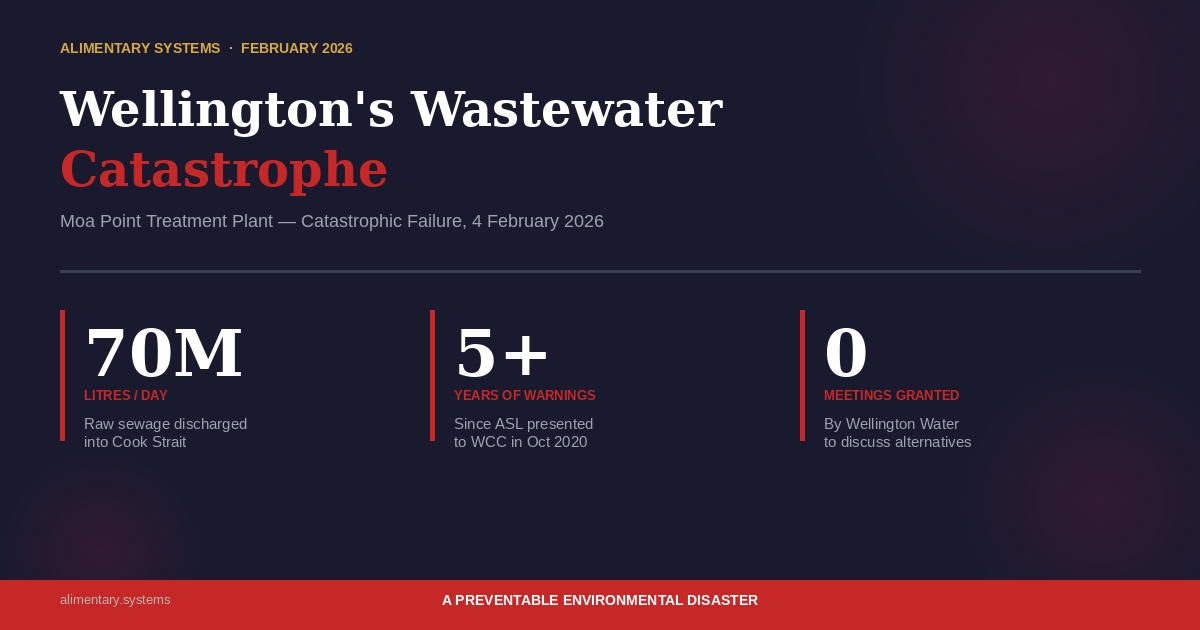
The Department of Conservation expressed serious concern. DOC's principal marine science advisor, Shane Geange, noted that raw sewage carrying bacteria, viruses and parasites posed an immediate threat to sponges, mussels, fish, and the local penguin population. The Taouteranga Marine Reserve — just 2km from the discharge point — sits in the path of contamination. South Coast beaches were closed and kaimoana collection was suspended.
Redirecting the overflow further out to sea could take months. Even once the longfall pipe is restored, Wellington Water acknowledged that raw sewage would still need to be periodically pumped near the shore due to limited capacity in the temporary arrangement.
Water NZ CEO Gillian Blythe highlighted what many in the sector already understood: New Zealand needs sustained investment in water infrastructure.
These are challenges we've been aware of for some time.
Our Involvement Goes Back to Before ASL Existed
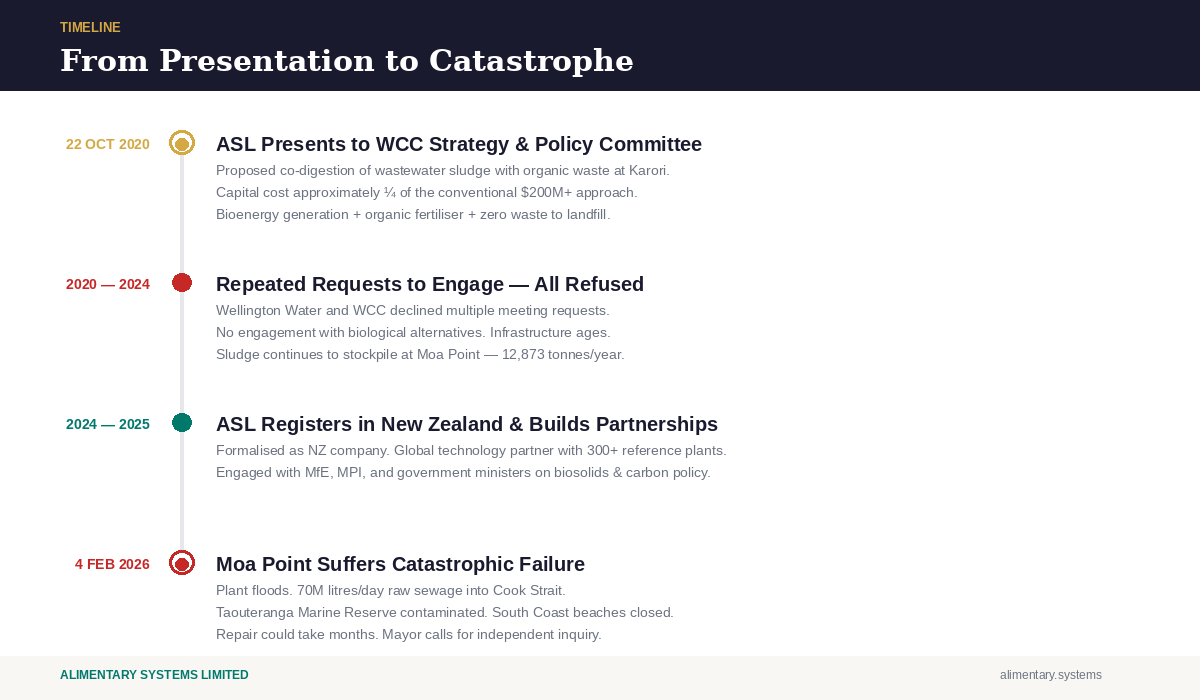
On 22 October 2020 — more than five years before this event, and four months before Alimentary Systems Limited was incorporated as a New Zealand company — the founders of what would become ASL presented to the Wellington City Council Strategy & Policy Committee.
ASL did not yet exist as a company. We were two people with deep domain expertise and a proven international technology partner. Our message was that New Zealand's wastewater sector faced growing pressure, and that circular approaches offered a viable path forward.
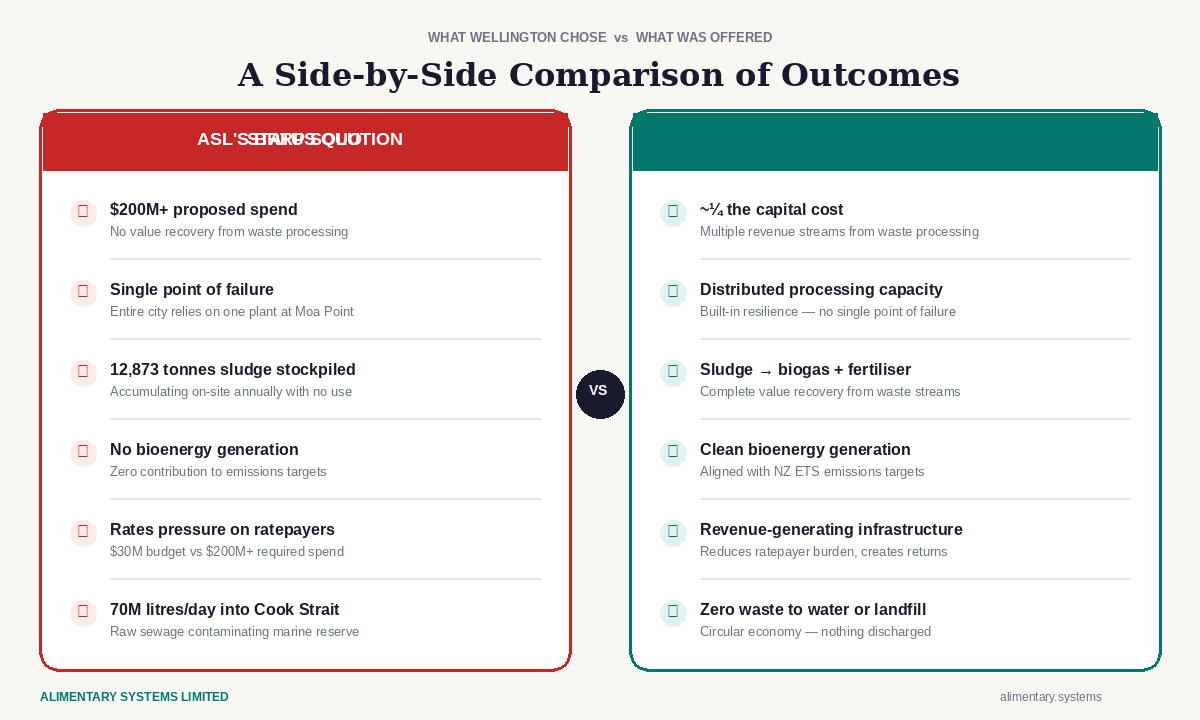
Our presentation outlined co-digestion of wastewater sludge with organic waste streams — food waste, green waste — to produce bioenergy and organic fertiliser. Rather than treating waste solely as a liability, we proposed treating it as a feedstock. The technology prevents wastewater sludge from being discharged to land or water, reduces emissions from processing, and generates revenue from what would otherwise be a cost centre.
We proposed discussing how a biological approach could work at Karori, processing 2–3 tonnes per day, at a capital cost significantly lower than what was being considered through conventional methods.
Unfortunately, the conversation didn't progress beyond that initial presentation. We weren't able to secure follow-up meetings to explore the approach further. We went on to incorporate ASL on 10 February 2021 and built the company from Christchurch.
Why This Matters Now
The Moa Point event has brought into sharp focus the vulnerability of concentrated wastewater infrastructure. When a city relies heavily on a single treatment facility — as Wellington does — any failure at that facility affects the entire system.
Moa Point is Wellington's primary wastewater treatment facility. According to national WWTP data from 2019–2020, the plant processes approximately 25.6 million cubic metres of wastewater annually, serving a population of around 158,000. It produces roughly 12,873 tonnes of sludge per year — sludge that has been stockpiled on-site with no value recovery.
Wellington Water manages just two plants across the region, processing 27.3 million cubic metres per year combined. This concentration means there is limited redundancy when things go wrong.
ASL's Bioresource Recovery Plant (BRRP) technology is designed to help address this kind of challenge. Co-digestion creates distributed processing capacity. It diverts organic waste from landfill. It produces biogas for clean energy and fossil-free organic fertiliser. It reduces the volume and toxicity of sludge. And it does so while generating multiple revenue streams rather than relying solely on ratepayer funds.
A Nationwide Challenge — Now Confirmed by the Regulator
Wellington's situation is significant, but it reflects broader pressures across the country. On 11 February 2026, New Zealand's water regulator Taumata Arowai appeared before a select committee and outlined the scale of the challenge. Chief executive Allan Prangnell confirmed that approximately one third of New Zealand's 320 wastewater treatment plant consents have expired — some for as long as 20 years. He acknowledged that the risk of a similar event happening elsewhere is not yet fully understood.
More than half of all wastewater overflows occurring around the country are not consented. Underground pipes — accounting for roughly 80 percent of the overall three waters network — are in many cases of unknown condition.
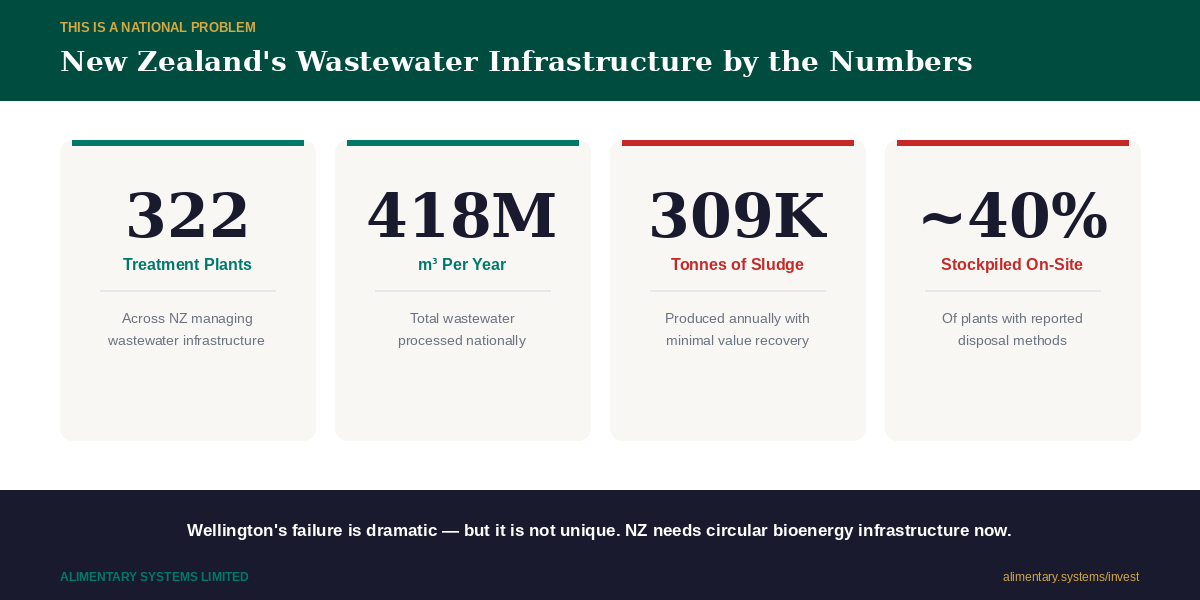
Across New Zealand, 322 wastewater treatment plants manage 418 million cubic metres of wastewater annually, producing over 309,000 tonnes of sludge. Approximately 40% of plants with reported disposal methods stockpile sludge on-site. Another 30% send it to landfill. Only a fraction recover any value.
The infrastructure is ageing. Consents are expiring. Regulatory expectations are increasing. And as the NZ Emissions Trading Scheme evolves — with the waste sector expected to contribute to New Zealand's emissions reduction targets — the case for circular solutions is strengthening.
What Our Technology Offers
ASL's BRRP technology offers a practical alternative to conventional sludge disposal. Co-digestion of wastewater sludge with organic waste produces biogas for clean energy generation, fossil-free organic fertiliser for agricultural use, and measurable emissions reductions. The distributed nature of the technology also builds resilience into the system — reducing dependence on any single facility.
Had we been able to progress the conversation that started in October 2020, Wellington could potentially have had additional processing capacity in place by now — creating both environmental and economic value from waste streams that are currently stockpiled or discharged.
We believe this approach has relevance not only for Wellington but for communities across New Zealand that are facing the same infrastructure pressures.
Where ASL Is Today
In October 2020, we were two founders without a company. Today, ASL is an incorporated New Zealand company (registered 10 February 2021) with proven technology, a global reference base of over 300 plants through our partners, and active engagement with the Ministry for the Environment and the Ministry for Primary Industries on national policy relating to biosolids, carbon, and green fertiliser standards.
We have modelled the economics at scale. We have the technology. We have regulatory alignment. And we remain ready to work with any community or organisation that sees value in turning waste into a resource.
The events at Moa Point are a reminder of why this work is urgent. We're committed to being part of the solution.
Alimentary Systems Limited (ASL) is a Christchurch-based circular bioenergy company that designs and builds Bioresource Recovery Plants (BRRPs) to convert organic waste into clean energy and valuable byproducts. For investment enquiries, visit alimentary.systems/invest or contact us at 09 390 4564.
Sources:
- NZ Herald, "Screened wastewater now being discharged straight into Cook Strait," 5 February 2026
- Newstalk ZB, "Gillian Blythe: Water NZ CEO on the need to invest in water infrastructure," 6 February 2026
- RNZ, "DOC becoming 'extremely concerned' about Wellington sewage leak," 5 February 2026
- RNZ, "Fears of another Moa Point, as scale of wastewater plants problem revealed," 11 February 2026
- ASL Presentation to WCC Strategy & Policy Committee, 22 October 2020
- NZ Wastewater Treatment Plant Data, 2019–2020